 628
628 


About Documents
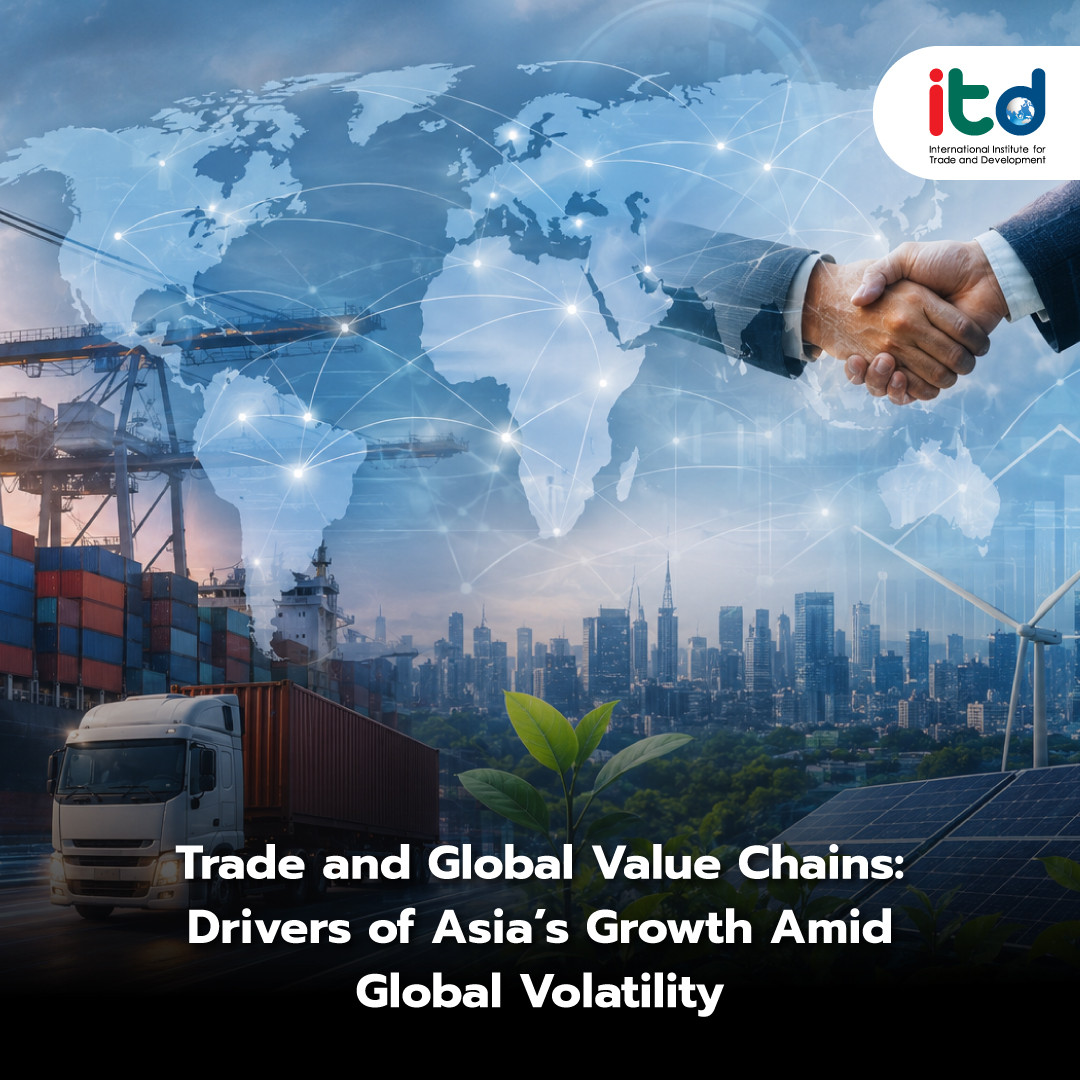
The Asian Economic Integration Report (AEIR) 2026 published by the Asian Development Bank highlights a significant finding: despite mounting global challenges arising from geopolitical tensions, climate change, and economic slowdowns across several regions, Asia and the Pacific continue to demonstrate strong economic resilience. In this context, trade and global value chains (GVCs) remain central mechanisms supporting economic growth and regional integration.
The report indicates that Asia and the Pacific have become a critical component of the global economic system. At present, the region accounts for approximately one-third of global trade linked to global value chains. Developing economies in Asia, in particular, increased their share of global markets from 9% in 2000 to 18% in 2023. This expansion has been driven by improvements in production efficiency, the development of increasingly sophisticated production networks, and stronger regional economic connectivity.
Nevertheless, AEIR 2026 notes that the benefits of growth have not been evenly distributed across the region. Economies in East Asia and Southeast Asia remain the primary beneficiaries of regional integration, whereas South Asia and Central Asia continue to experience relatively low levels of integration and face structural barriers to deeper participation in higher-value segments of global value chains.
One of the most significant issues affecting trade and supply chain development is the growing level of global uncertainty, which has altered traditional trade structures. Geopolitical polarization has accelerated the concept of “friend-shoring,” whereby production activities are relocated to politically aligned partner countries. These developments have contributed to the fragmentation of existing supply chains.
The Asian Development Bank warns that such fragmentation may disproportionately affect low-income economies that rely heavily on exports of raw materials or intermediate goods. Without the capacity to adapt to emerging standards and newly formed production networks, these countries risk remaining trapped in low-value economic roles and losing opportunities for industrial upgrading.
Another major factor reshaping global value chains is the rapid expansion of digital investment, which now represents approximately 35% of total foreign investment in the region. A substantial proportion of this investment is concentrated in artificial intelligence, data centers, and financial technology (fintech).
Digital technologies contribute to lower cross-border transaction costs and enable small and medium-sized enterprises (SMEs) to access international markets more effectively. In addition, artificial intelligence enhances supply chain management by improving risk forecasting and enabling firms to adjust transportation routes and production processes more rapidly during periods of disruption.
An increasingly important issue in global supply chain development is decarbonization within global value chains. In the contemporary global economy, participation in global value chains is no longer determined solely by low production costs. Environmental standards, sustainability practices, and traceability have become equally important considerations.
Asian economies are therefore under growing pressure to adopt green technologies in manufacturing processes, particularly as major trading partners such as the European Union and the United States begin implementing carbon border adjustment measures. Failure to adapt could significantly reduce the region’s long-term competitiveness.
To ensure the continued advancement of economic integration in Asia and the Pacific, the Asian Development Bank proposes three key policy directions. First, countries should strengthen economic resilience by diversifying sources of raw materials and export markets rather than depending excessively on a single country, while also investing in modern logistics infrastructure.
Second, policymakers should promote inclusiveness by supporting SMEs in gaining access to financing and digital platforms. Such measures would help distribute the benefits of global trade more broadly across society rather than concentrating them among large multinational corporations alone.
Third, the report emphasizes the importance of regional cooperation. Reducing tariffs alone is insufficient; economies must also enhance regulatory cooperation, trade facilitation, and the harmonization of standards in order to reduce hidden business costs and improve regional economic efficiency.
Ultimately, the report reaffirms that trade and global value chains remain fundamental engines of prosperity in Asia. However, under rapidly changing global conditions, future success will depend on the region’s ability to adapt to the digital economy, maintain commitments to environmental sustainability, and strengthen regional cooperation in response to increasing uncertainty. If Asia and the Pacific can successfully address these challenges, the region may evolve beyond its role as the “factory of the world” to become a global center for innovation and sustainability in the twenty-first century.
Author:
Mr. Wimon Punkong
Deputy Executive Director (Academic)
International Institute for Trade and Development (ITD)
www.itd.or.th
Publication: Bangkok BIZ Newspaper
Section: First Section/World Beat
Volume: 39 Issue: 13161
Date: Wednesday, May 13, 2026
Page: 8 (bottom)
Column: “Asean Insight”