 22
22 


About Documents
ASEAN is one of the world’s fastest-growing economic regions. According to the International Monetary Fund (IMF), ASEAN recorded an average economic growth rate of 4.9% in 2025. However, economic growth has also brought environmental impacts from industrial development and urbanization.
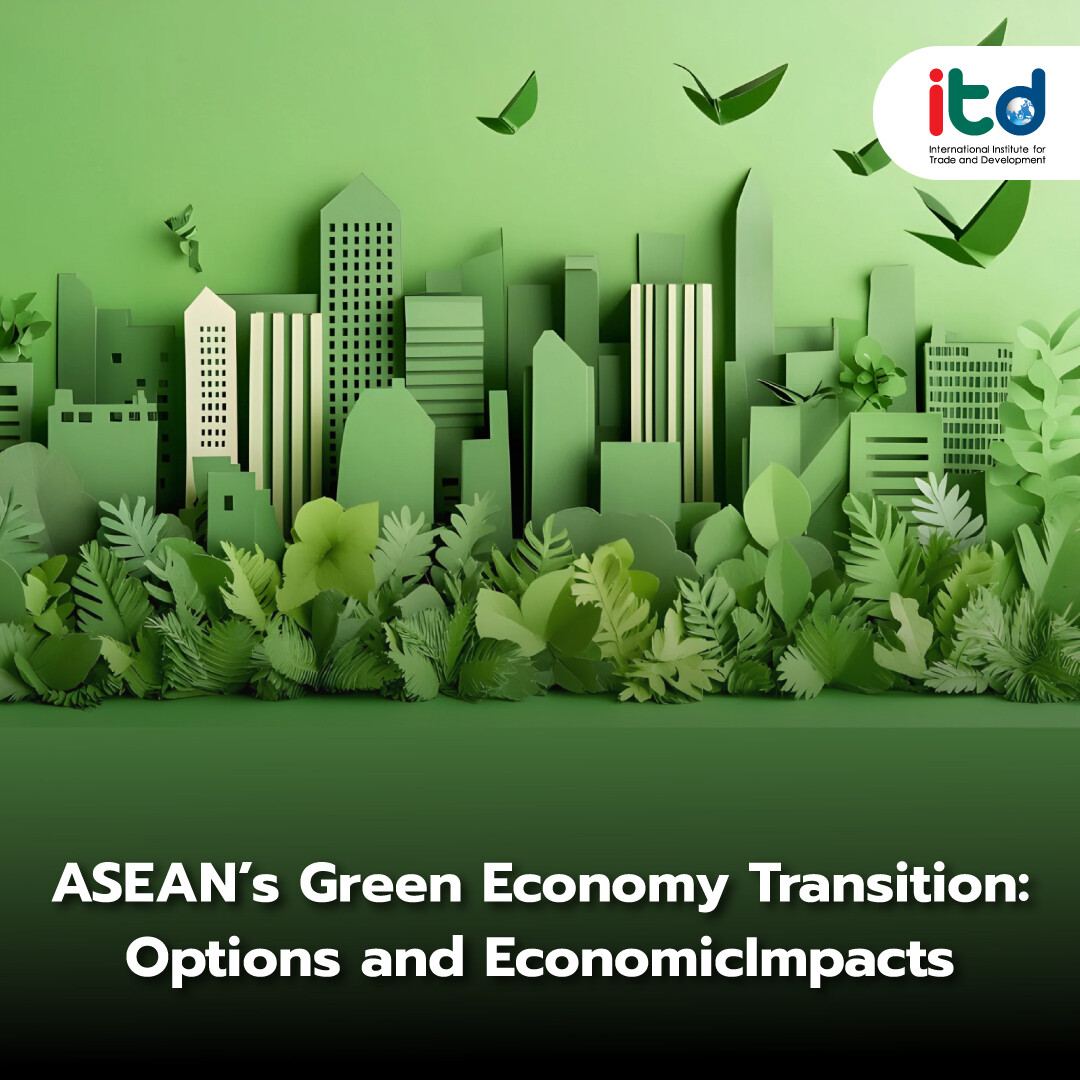
To sustain economic growth while reducing environmental impacts, ASEAN has been working toward a transition to a green economy. This transition is gaining momentum. Bain & Company and Standard Chartered estimate that the green economy market in the SEA-6 countries, comprising Indonesia, Malaysia, the Philippines, Singapore, Thailand, and Viet Nam, will grow from US$290 billion in 2025 to US$430 billion by 2030. An important question, however, is whether ASEAN countries will experience the same economic impacts if they pursue the green transition with different levels of policy ambition.
The Asian Development Bank’s report Advancing the Green Economy Transition in ASEAN assesses the impacts of the transition across different groups of ASEAN economies under three scenarios: (1) continuation of existing policies without additional policy changes or green investment; (2) implementation of each country’s greenhouse gas emission reduction targets under its Nationally Determined Contributions (NDCs); and (3) implementation of NDCs combined with productivity improvements in green economy sectors.
The study finds that the economic impacts vary across country groups. Implementing NDCs alone reduces GDP in rapidly developing economies, namely Indonesia, the Philippines, Thailand, and Viet Nam. In contrast, advanced economies, comprising Brunei Darussalam, Malaysia, and Singapore, as well as developing economies, comprising Cambodia, the Lao People’s Democratic Republic, and Myanmar, experience only limited adverse effects or an increase in GDP compared with the scenario in which existing policies continue without additional policy changes or green investment.
Combining NDC implementation with productivity improvements in green economy sectors helps mitigate the adverse effects on rapidly developing economies. At the same time, advanced and developing economies experience stronger economic growth. Productivity improvements in green economy sectors also lead to higher exports across all country groups, with particularly notable gains among rapidly developing and developing economies.
Beyond their effects on economic growth and trade, green economy policies also lead to changes in ASEAN’s sectoral production structure. Under the scenario combining NDC implementation with productivity improvements in green economy sectors, industries such as hydropower, metals, and construction benefit from green investment and technological upgrading.
Other sectors, including textiles and forestry, are likely to experience declines in output. This partly reflects resource reallocation toward sectors with higher productivity or greater competitiveness. Meanwhile, traditional manufacturing sectors, such as chemicals and machinery, show moderate expansion under the NDC scenario but little additional change when productivity improvements are introduced. This suggests that these sectors may require structural adjustment alongside investment in cleaner production technologies.
The green economy transition also has different employment effects across country groups. Developing economies are likely to experience employment gains both under NDC implementation alone and when NDCs are combined with productivity improvements. In contrast, rapidly developing economies experience job losses under the NDC scenario, with employment recovering only slightly even after productivity improvements are introduced. These findings highlight the need for policies that support workers during the transition.
Overall, the impacts of the green economy transition are uneven across ASEAN. Some country groups bear greater adjustment costs than others. Nevertheless, combining NDC implementation with productivity improvements in green economy sectors represents an important approach to mitigating the economic costs of the transition and enabling its benefits to be distributed more evenly across the region.
Author:
Ms. Natjaree Petruang
Researcher
International Institute for Trade and Development (ITD)
www.itd.or.th
Publication: Bangkok BIZ Newspaper
Section: First Section/World Beat
Volume: 39 Issue: 13251
Date: Wednesday, Sep. 16, 2026
Page: 8 (bottom)
Column: “Asean Insight”