 335
335 


About Documents
At present, Thailand’s economic development continues to face the challenge of transcending the “Middle-Income Trap”—a state in which a country successfully transitions from low-income to middle-income status within a relatively short timeframe (“income” referring to Gross National Income (GNI) per capita), yet subsequent economic growth decelerates significantly, leaving the country stuck in the middle-income bracket. Thailand was elevated to middle-income status in 1976. However, as of 2024, Thailand’s GNI per capita stands at approximately USD 7,100, indicating that the country has been trapped in middle-income status for over 50 years. According to World Bank criteria updated as of July 1, 2024, a country must achieve a GNI per capita exceeding USD 14,005 to be classified as a high-income nation; thus, Thailand still faces a substantial gap to bridge in reaching high-income status.
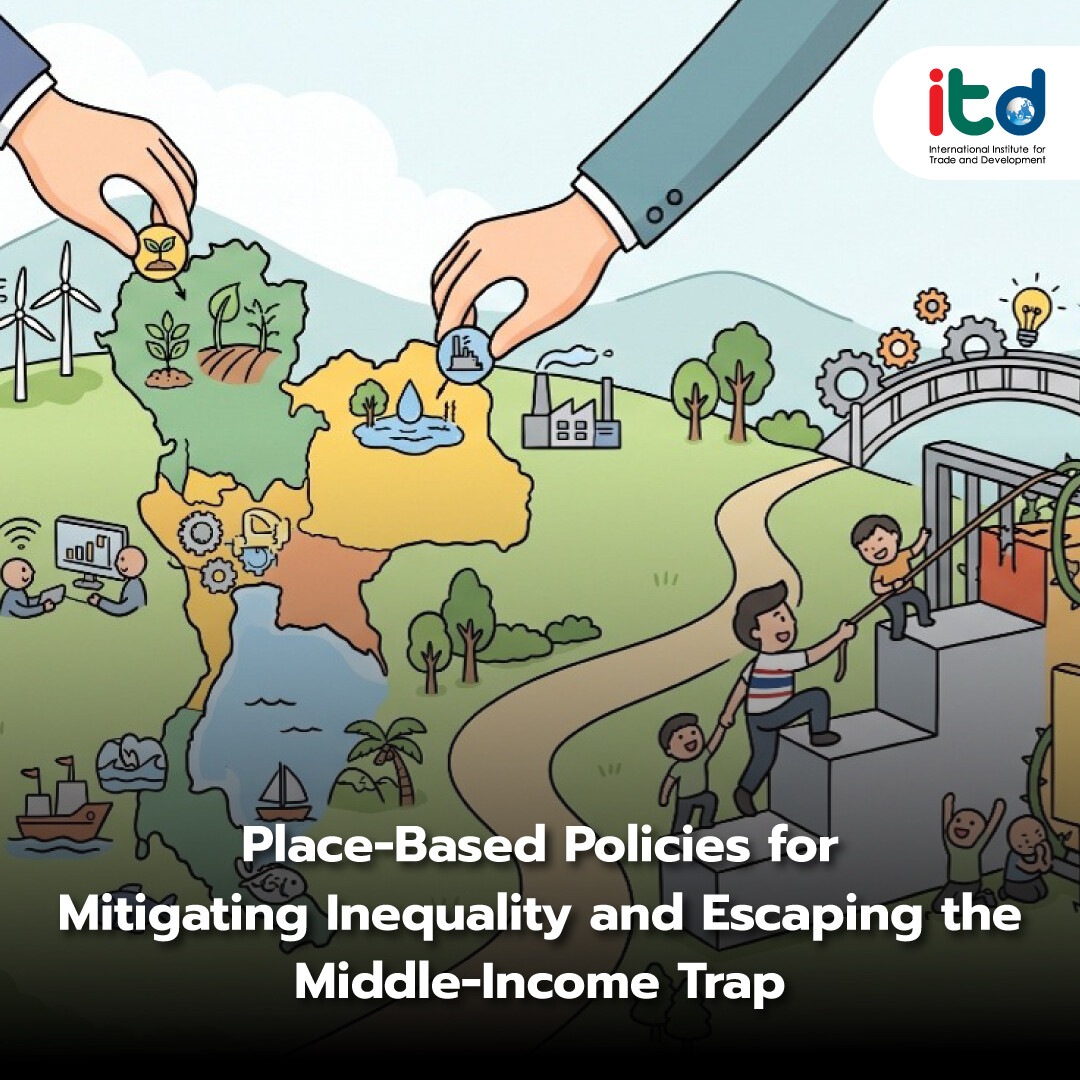
In addition to the challenge of transcending the “Middle-Income Trap,” regional economic inequality represents another critical hurdle impacting long-term macroeconomic stability and sustainability. A clear manifestation of this in Thailand is seen in the development and growth trajectory of its Special Economic Zones. Currently, Thailand designates six major economic zones and corridors: the Eastern Economic Corridor (EEC), the Northern Economic Corridor (NEC), the Northeastern Economic Corridor (NeEC), the Central-Western Economic Corridor (CWEC), the Southern Economic Corridor (SEC), and border Special Economic Zones (SEZs). However, growth efficiency continues to highlight spatial economic concentration. For instance, data from the National Statistical Office (NSO) in 2022 reveals that the EEC generated the highest Gross Provincial Product (GPP), totaling 2,698,343 million THB, whereas the NEC recorded the lowest at a mere 516,819 million THB—a disparity of more than fivefold. Furthermore, in 2023, the EEC secured the highest value of investment promotion applications at 379,766 million THB, while the SEC received the lowest at only 2,727 million THB.
Therefore, formulating competitiveness development strategies urgently necessitates the application of “place-based policies” to address regional economic and social disparities distributed unevenly across the country. As defined by the Organisation for Economic Co-operation and Development (OECD), “place-based policies” refer to measures that are intentionally spatially-targeted to enhance the long-term economic performance and well-being of specific geographic areas. The design of such policies emphasizes context-sensitivity, recognizing the unique needs, resources, and opportunities inherent to each region in order to unlock underutilized potential. A prominent international precedent is the European Union’s (EU) “Just Transition Fund,” established to provide targeted assistance to regions and workers most severely affected by the transition toward carbon neutrality, particularly areas heavily reliant on coal mining or traditional energy industries.
Consequently, “one-size-fits-all” policies designed for all demographic groups, locations, or scenarios are inherently insufficient for addressing crises with asymmetric regional impacts, such as climate change or demographic decline. The government must effectively harness local potential and resources in a targeted manner to drive inclusive and efficient growth. Crucially, the success of these place-based policies hinges on integrated public-private partnerships, ensuring sustainable economic expansion and enabling the nation to break out of the middle-income trap in the future.
Author:
Mr. Atit Saerepaiboonsub
Senior Researcher
International Institute for Trade and Development (ITD)
www.itd.or.th
Publication: Bangkok BIZ Newspaper
Section: First Section/World Beat
Volume: 39 Issue: 13236
Date: Wednesday, Aug. 26, 2026
Page: 8 (bottom-left)
Column: “Asean Insight”