775
775 


About Documents
Amid rapid and severe changes in the global economy, the year 2568 (2025) is
becoming a major turning point that will determine which businesses can survive in
the long term. A notable OECD study, The Best versus the Rest (2568), which
examines the global slowdown in productivity, shows a clear reality: the business
world is increasingly divided into two groups. The first is a group of “frontier firms”
that lead through advanced innovation. The second is a group of “lagging firms” that
continue to fall further behind.
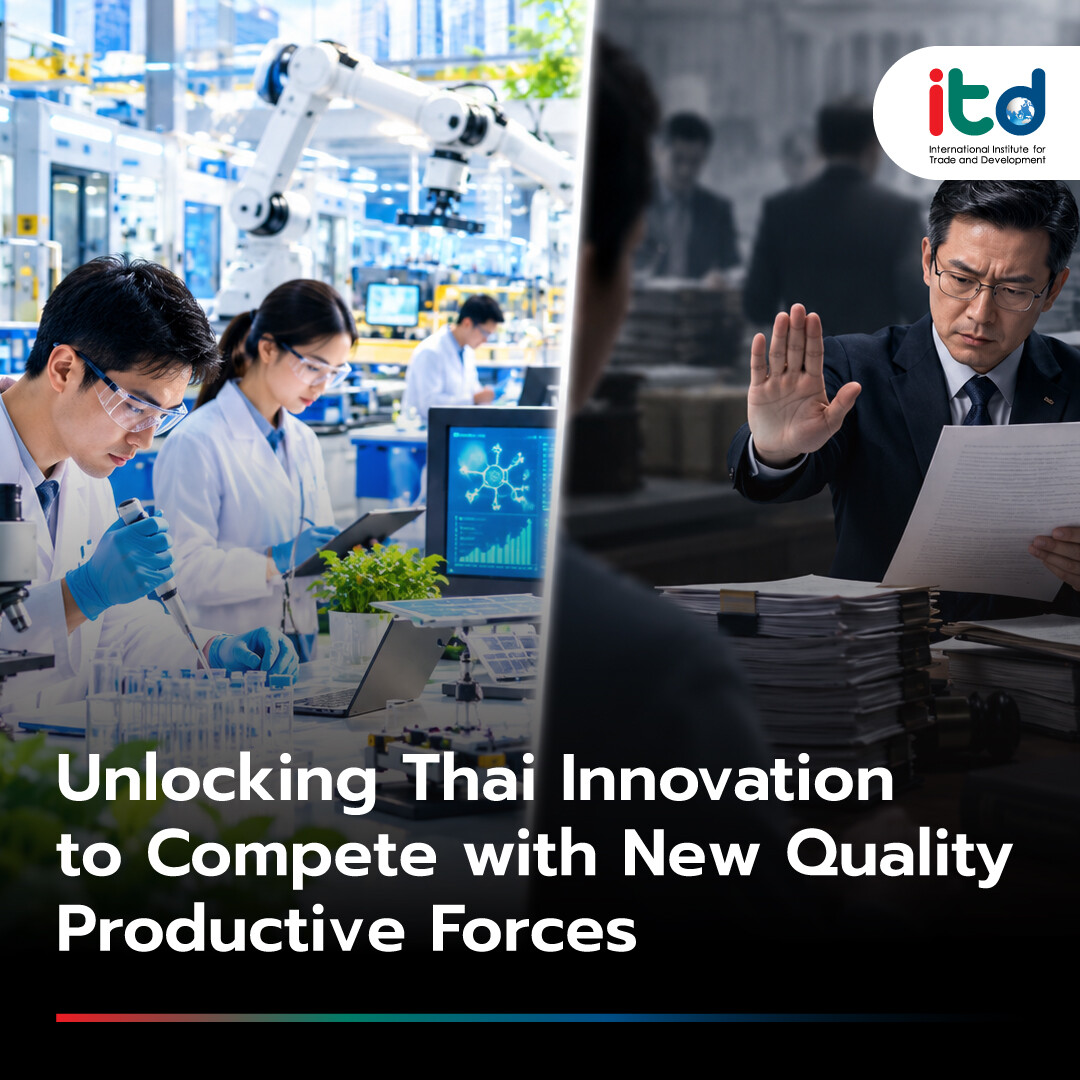
The key question for Thai entrepreneurs today is what kind of distinct value they can
create that the global market is willing to pay for. Economic indicators clearly show
that the old success model, which relied on low-cost labor and contract
manufacturing, is reaching its limit. The remaining path forward is to accelerate the
transition to an innovation-driven economy, based on creativity and technology.
For several decades, Thailand’s growth has been supported by cost advantages,
competitive wages, and its role as an original equipment manufacturer (OEM) for
global brands. However, today’s trade environment has changed completely. Thailand
now faces price competition from large economies with massive production capacity.
Low-cost goods flow freely through cross-border e-commerce, while major Western
3
trading partners impose indirect trade barriers through environmental, labor, and
sustainability (ESG) requirements.
Thailand cannot produce goods more cheaply or more quickly than countries with
much larger economies. The World Bank’s Thailand Economic Monitor (2568)
emphasizes that upgrading innovation capabilities among small and medium-sized
enterprises is a necessary condition for business survival. In this new trade
environment, if Thailand continues to compete mainly on price and volume, it will
lose from the outset.
For Thai businesses, innovation can begin in simple ways by rethinking how to add
value to existing resources. Examples include extracting high-value compounds from
durian peels instead of selling fresh durians with seasonal price volatility, or shifting
from stamping automotive parts to developing sensors for electric vehicles.
Thailand does not start from zero. The country has strong existing foundations which,
when combined with appropriate technology, can enable meaningful progress. Key
areas include:
- Food and agricultural innovation (FoodTech / AgriTech): Thailand should
move from being the “kitchen of the world” to the “kitchen of the future,”
focusing on food solutions such as alternative proteins, functional foods, and
personalized nutrition designed around genetics and lifestyle. - Creative economy: By linking cultural assets with digital platforms, Thailand
can export soft power and create new experiences that increase income for
artists and local communities. - Health and wellness services (Wellness Tech): By applying data and AI to
in-depth health analysis, personalized treatment design, and integrated
hospital, spa, and online services, the economic value of health tourism can
increase substantially.
This transition is not the responsibility of any single sector. The private sector must
view research and development as an investment in the future, while the government
must accelerate the removal or relaxation of outdated regulations, allow new
businesses to experiment, and support technological infrastructure.
It is time for Thai entrepreneurs to become creators who shape market direction
themselves. In today’s world, survival is not a matter of choice, but a decision made
now: whether to be left behind, or to define the path to the future with their own
hands.
Author:
Mr. Kamol Panmuang
Senior Researcher
International Institute for Trade and Development (ITD)
www.itd.or.th
Publication: Bangkok BIZ Newspaper
Section: First Section/World Beat
Volume: 39 Issue: 13056
Date: Wednesday, Dec. 17, 2025
Page: 8 (bottom)
Column: “Asean Insight”