 620
620 


About Documents
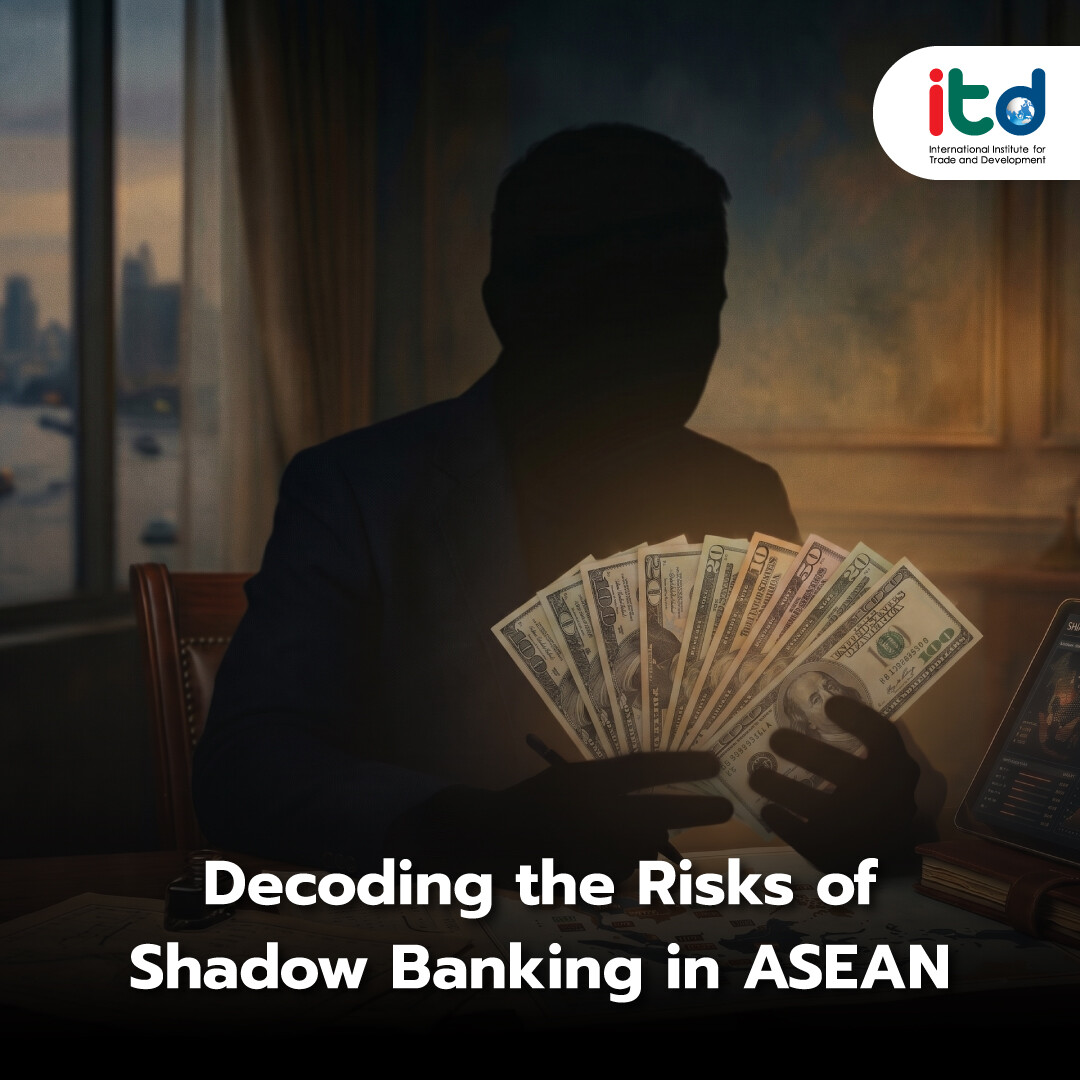
Amid an increasingly uncertain globalized world, the financial sector has become one of the most critical and closely scrutinized sectors. This is because finance is not only a key instrument in geopolitical and geoeconomic competition, but also a potential source of volatility within the global economy. Financial speculation can generate systemic risks that spill over into the real economy, affecting businesses, employment, and economic growth.
Traditionally, commercial banks have played a central role in the financial system as regulated financial intermediaries operating under the supervision of national central banks. However, as global economic conditions become more volatile and complex, attention has increasingly shifted beyond conventional banking institutions. Alongside commercial banks, shadow banks have emerged as significant actors within the financial ecosystem and are now attracting growing scrutiny from regulators, policymakers, and market participants alike.
Shadow banks – including finance and credit guarantee companies, hedge funds, money market mutual funds, and savings cooperatives – play an important role in the financial system. They provide depositors with confidence that the returns earned in the form of interest will be worthwhile, while also expanding access to funding for businesses and investors seeking capital to support their operations and investment activities. In doing so, they offer an alternative source of financial intermediation beyond traditional commercial banking services.
However, shadow banking activities have increasingly expanded beyond their conventional scope. In recent years, shadow banks have become more involved in transactions with commodity trading firms, particularly in the food and agricultural sectors, assuming functions that increasingly resemble those of commercial banks within the broader financial system.
According to the 2025 report by UN Trade and Development (UNCTAD), major agricultural and food commodity trading companies have fundamentally transformed their business models. Rather than relying primarily on banks for risk management, as they did in the past, many firms have increasingly engaged directly in derivatives markets for speculative purposes. By capitalizing on periods of heightened volatility and surging global food prices triggered by crises, these companies have been able to generate substantial profits from widening price differentials.
While this strategy serves as an effective financial hedge for the companies themselves, it may also contribute to keeping global food prices elevated, thereby exacerbating the burden on consumers and food-importing economies.
Shadow banking is not a new phenomenon. However, the financial engineering techniques employed to generate profits have become significantly more sophisticated. Commodity trading firms have increasingly restructured lower-quality assets into debt securities through securitization processes and subsequently used these newly created financial instruments as the basis for extending credit and generating additional returns. As a result, such firms are taking on functions that increasingly resemble those of financial intermediaries within the broader shadow banking system.
The report highlights the enormous scale of financial instruments used as intermediaries in global commodity trading. Since 2023, the value of assets held by shadow banking institutions in global financial markets has surged to account for 49.1% of total financial assets – equivalent to nearly twice the size of the United States’ gross domestic product (GDP). Furthermore, in 2025, assets managed by shadow banking entities expanded by 8.5%, a growth rate nearly three times higher than that of conventional commercial banks, whose assets grew by only 3.3%.
The risks associated with unsecured lending by shadow banks could become a ticking time bomb for the global financial system should a large number of borrowers default simultaneously. This scenario bears striking similarities to the 2008 subprime mortgage crisis, which originated in the U.S. housing market before cascading through the global financial system and triggering widespread institutional failures.
Although the international regulatory framework under Basel III was developed to address many of the vulnerabilities exposed by the global financial crisis, its scope remains insufficient to comprehensively monitor and regulate activities within the shadow banking sector. This challenge is particularly evident in Southeast Asia, where shadow banking institutions are expanding rapidly through the development of increasingly sophisticated financial products, including COVID-19 insurance schemes, equity mutual funds, and pension funds. The emergence of these instruments has created new areas of financial vulnerability that remain subject to relatively limited regulatory oversight.
Although the Basel III framework introduced more stringent regulatory requirements by mandating higher levels of risk-weighted capital and collateral backing for lending activities, these measures have also created significant challenges for financial risk management. Excessively stringent regulations can constrain commercial banks’ ability to extend credit to small and medium-sized enterprises (SMEs), many of which may lack sufficient collateral despite having legitimate financing needs. Moreover, such requirements can complicate coordination among regulatory authorities and financial institutions in the assessment and approval of large-scale investment projects. This is particularly relevant in ASEAN, where substantial financing is required to support the development of environmentally sustainable and green infrastructure.
Against this backdrop, ASEAN’s key policy challenge is not merely to impose stricter controls aimed at curbing the growth of shadow banking activities. Rather, it is to strengthen regional regulatory cooperation in order to enhance transparency in off-balance-sheet transactions and improve the monitoring of emerging financial risks. This includes shifting supervisory approaches toward activity-based regulation, whereby oversight focuses on the nature of financial activities rather than the type of institution conducting them.
At the same time, policymakers must develop effective mechanisms to channel capital safely into the real economy, particularly toward grassroots economic development and sustainable development objectives. Such efforts are essential to preventing the accumulation of systemic risks and safeguarding the long-term stability and resilience of the region’s financial system.
Author:
Mr. Pipatpong Chooprasiti
Academic Officer
International Institute for Trade and Development (ITD)
www.itd.or.th
Publication: Bangkok BIZ Newspaper
Section: First Section/World Beat
Volume: 39 Issue: 13191
Date: Wednesday, Jun. 24, 2026
Page: 12 (bottom), 8
Column: “Asean Insight”