 364
364 


About Documents
The global economy is facing heightened volatility amid shifts in both geopolitics and climate conditions. Against this backdrop, the resilience and performance of economies across Asia and the Pacific are once again being tested. According to the Asian Development Bank’s (ADB) September 2026 Asian Development Outlook, economic growth in developing Asia and the Pacific is projected to slow to 5.0% in 2026, down from 5.5% in 2025.
Economic activity across Asia and the Pacific continues to be supported by intraregional trade and investment, government stimulus measures, and rapid expansion in high-technology industries associated with the global artificial intelligence (AI) investment cycle. Nevertheless, the region’s economic outlook remains subject to significant risks, particularly those arising from energy market disruptions and the effects of climate change.
Economic recovery across Southeast Asia, or the Association of Southeast Asian Nations (ASEAN), remains uneven. The ADB has slightly revised upward its growth projections for the region to 4.7% in 2026 and 4.9% in 2027. Key drivers include technology manufacturing hubs such as Vietnam and Malaysia, which have benefited from stronger exports of electronics and computing equipment. Vietnam stands out, with economic growth projected to reach 7.8% in 2026, supported by continued infrastructure investment.
Indonesia is expected to maintain steady economic expansion at 5.2%. In contrast, the Philippines faces constraints from persistently high inflation and a prolonged contraction in the construction sector. These differences indicate that economic momentum across ASEAN remains unevenly distributed.
Thailand’s economy is projected to grow by 2.0% in 2026 and 1.9% in 2027. Headline inflation is expected to stand at 2.5% in 2026 before declining to 1.3% in 2027. A key source of support for the Thai economy is private investment in future-oriented technology industries, particularly the construction of data centers and digital infrastructure required to support AI technologies.
However, Thailand faces significant pressures from both trade and tourism. Although exports of technology products have increased, the country must import substantial quantities of relatively expensive raw materials and capital goods. Combined with rising maritime freight costs, these factors mean that net trade has become a drag on economic growth.
Thailand’s tourism sector has also been directly affected by conflict in the Middle East. Higher aviation fuel prices and airline route adjustments have contributed to a decline in arrivals from the Middle East, a relatively high-spending visitor segment. According to the figures presented in the report, arrivals from this market fell by 25% during the first half of the year.
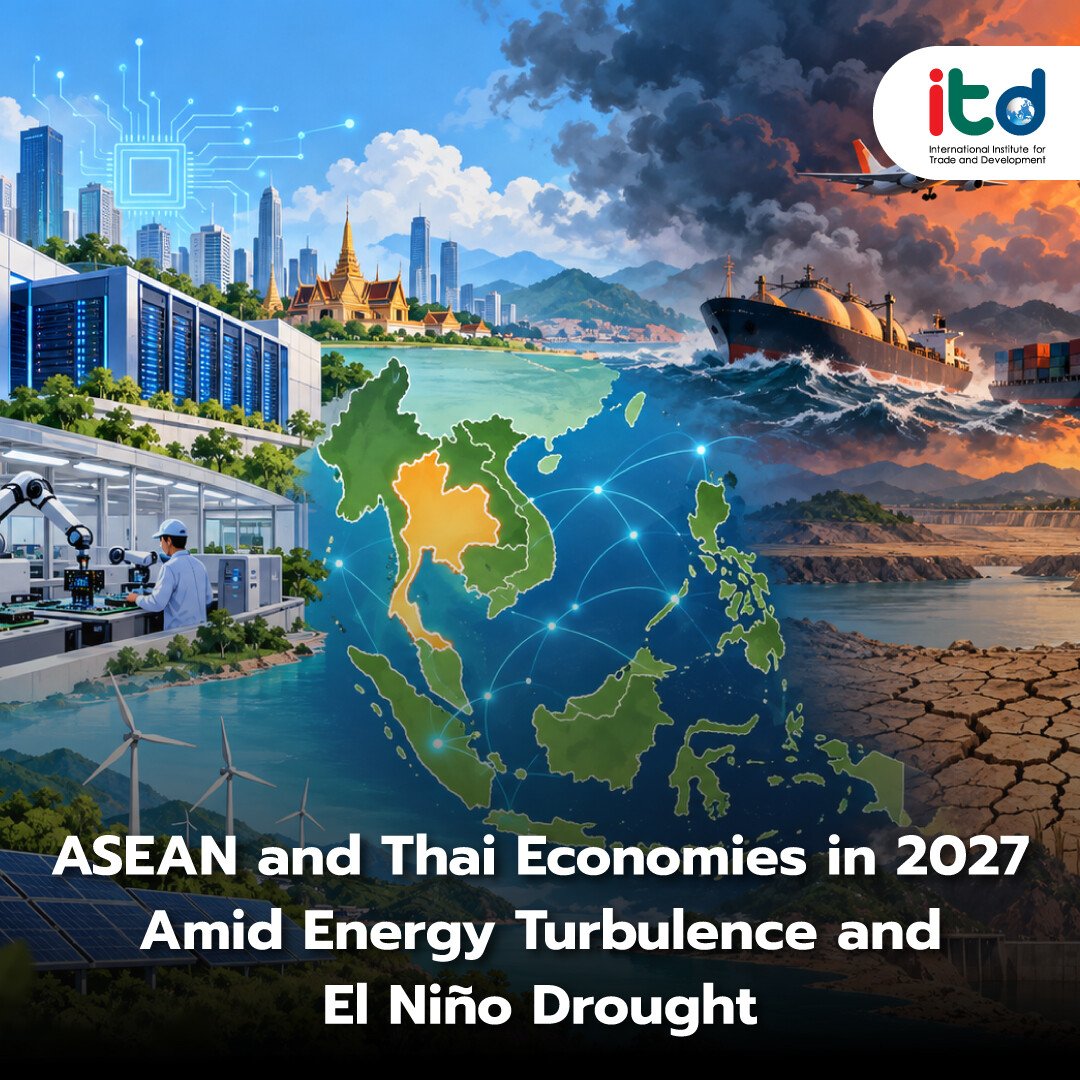
A broader challenge affecting both ASEAN and Thailand is the combination of energy price pressures and climate-related shocks. The escalation of conflict in the Middle East has increased risks to major global oil and natural gas shipping routes, including the Strait of Hormuz and the Red Sea. As a result, refining margins for petroleum products, particularly diesel and jet fuel, have risen to as much as three times their normal levels. This has imposed substantial additional costs on transportation, agriculture, and industrial production across the region.
ASEAN is also expected to face a very strong El Niño event, which is projected to peak toward the end of 2026 and have continuing effects throughout 2027. Abnormally dry conditions could reduce agricultural output, particularly rice and other major crops. Lower reservoir levels could also constrain hydropower generation, potentially forcing several countries to rely more heavily on fossil fuels and relatively expensive liquefied natural gas (LNG). Such developments would further increase household living costs and production costs.
These economic disruptions are occurring at a time when several ASEAN economies are carrying historically high levels of public and private debt. High indebtedness has therefore become a structural constraint on the scope for both monetary and fiscal policy responses.
The ADB report signals that ASEAN economies, including Thailand, need to move beyond predominantly reactive policy responses toward more proactive and anticipatory measures. Preparations for drought should include distributing drought-resistant crop varieties to farmers, improving water-resource management, and establishing targeted social assistance mechanisms in advance of severe climate-related disruptions.
Over the longer term, accelerating structural reform of the energy sector toward renewable energy and improving energy efficiency will be essential to reducing exposure to global energy price volatility. These measures should be pursued alongside fiscal discipline to strengthen economic resilience against future external shocks.
Author:
Mr. Wimon Punkong
Deputy Executive Director (Academic)
International Institute for Trade and Development (ITD)
www.itd.or.th
Publication: Bangkok BIZ Newspaper
Section: First Section/World Beat
Volume: 39 Issue: 13261
Date: Wednesday, Sep. 30, 2026
Page: 8 (bottom)
Column: “Asean Insight”