 448
448 


About Documents
The agricultural sector in ASEAN plays a key role in ensuring food security and supporting the region’s economic growth. Data from the ASEAN Secretariat indicate that in 2023, agriculture, forestry, and fisheries together were valued at approximately USD 3.8 trillion, accounting for 9.6% of ASEAN’s GDP, and providing employment for more than 93 million people.
However, ASEAN’s agricultural sector is facing increasing pressure from multiple factors. These include an aging labor structure, as well as more frequent and severe climate change impacts and natural disasters. These factors contribute to a declining trend in agricultural output. More recently, the conflict between the United States-Israel and Iran, which began in late February 2026, has disrupted the supply chain of key agricultural inputs, particularly chemical fertilizers.
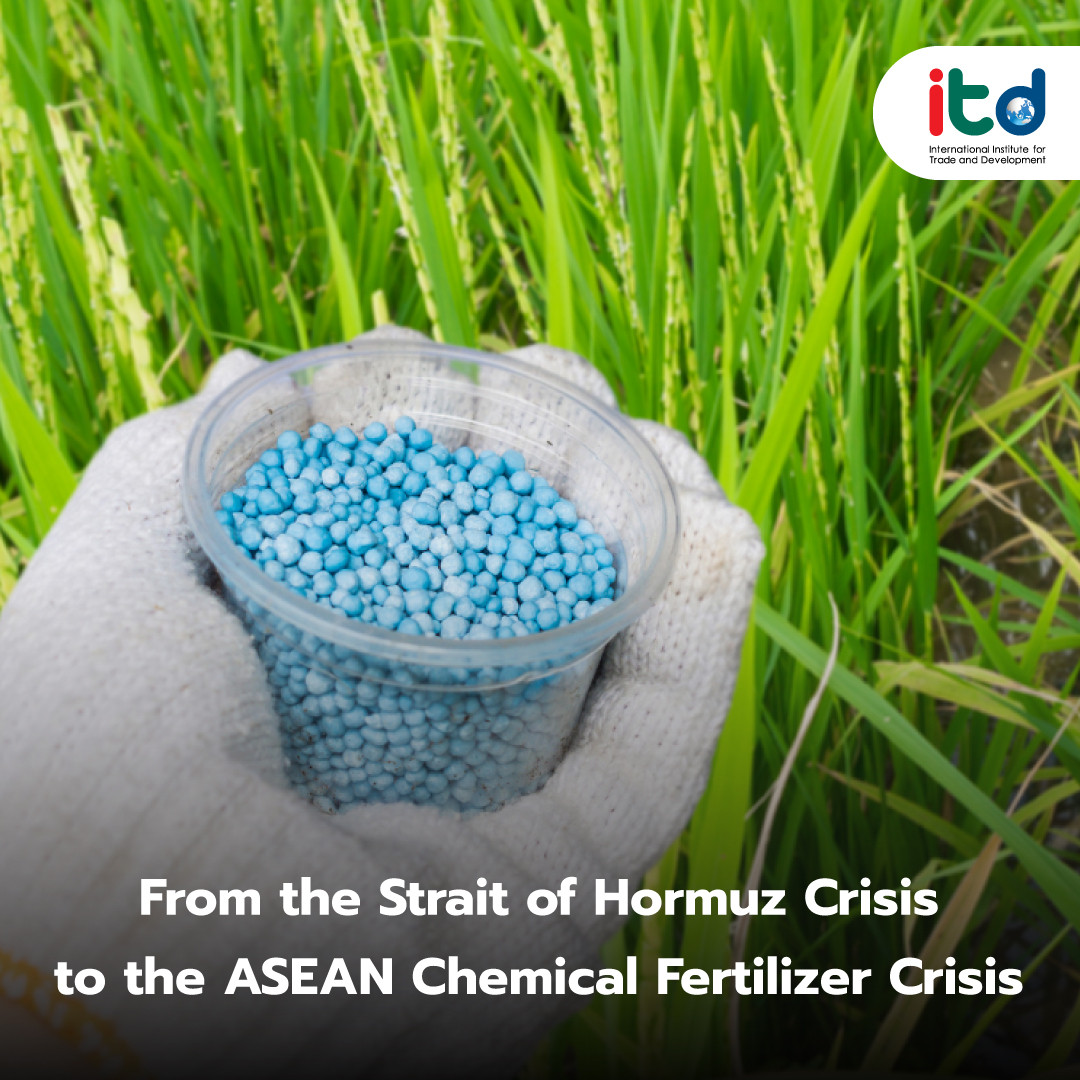
A report by the United Nations Conference on Trade and Development indicates that the conflict has affected major shipping routes such as the Strait of Hormuz, which is a critical route for transporting oil and chemical fertilizers. Approximately one-third of the global seaborne fertilizer trade passes through this route. Transportation disruptions have therefore increased fertilizer production and shipping costs, leading to greater food price volatility and affecting food security and agricultural trade in ASEAN.
Structurally, ASEAN remains highly dependent on chemical fertilizer imports from outside the region, accounting for more than 82%. Thailand clearly exemplifies this vulnerability, as it lacks upstream raw materials for producing straight fertilizers and therefore relies heavily on imports. According to Krungsri Research, imported fertilizers comprise approximately 66% straight fertilizers and 34% compound fertilizers. These imports are primarily used to meet domestic demand, with only a small share exported.
This structure makes chemical fertilizer costs and prices in Thailand highly sensitive to global market fluctuations. Other countries in the region, such as Cambodia and Myanmar, face similar vulnerabilities due to their limited domestic fertilizer production capacity and heavy reliance on imports. This situation highlights ASEAN’s ongoing structural exposure to volatility in the global fertilizer supply chain.
Vulnerability stemming from import dependence and potential disruptions in fertilizer transportation becomes more severe when considering the timing of fertilizer application in ASEAN’s agricultural sector. Analysis by the S. Rajaratnam School of International Studies (RSIS) at Nanyang Technological University highlights that March is a critical period for cultivation, particularly for rice, which is in a stage requiring intensive fertilizer use. At the same time, other crops at risk include maize in Indonesia, the Philippines, and Vietnam; soybeans in Indonesia and Vietnam; and sugarcane in the Philippines and Thailand.
As the season progresses into April, the risks continue to expand, affecting a broader range of key crops, including rice, maize, soybeans, sugarcane, and cassava across several ASEAN countries.
Disruptions in fertilizer imports are likely to reduce agricultural output. Rising fertilizer prices increase production costs, leading farmers to reduce fertilizer use in order to manage expenses. This, in turn, results in lower yields in subsequent production cycles. The impact extends beyond food security to ASEAN’s competitiveness in agricultural trade, especially in the context of global geopolitical uncertainty.
In the short term, ASEAN member states should diversify their sources of chemical fertilizer imports by expanding trade partnerships with new supplier countries. This would help reduce the risk of shortages and price volatility. In the long term, it is necessary to adjust fertilizer use practices while improving production efficiency. Promoting appropriate fertilizer application can reduce excessive use. In addition, supporting research and development to improve fertilizer efficiency, advancing and applying agricultural technologies, and encouraging the use of bio-fertilizers can help reduce exposure to global price volatility and strengthen the long-term resilience of ASEAN’s agricultural sector.
Author:
Ms. Natjaree Petruang
Researcher
International Institute for Trade and Development (ITD)
www.itd.or.th
Publication: Bangkok BIZ Newspaper
Section: First Section/World Beat
Volume: 39 Issue: 13151
Date: Wednesday, Apr. 29, 2026
Page: 23 (bottom)
Column: “Asean Insight”