 721
721 


About Documents
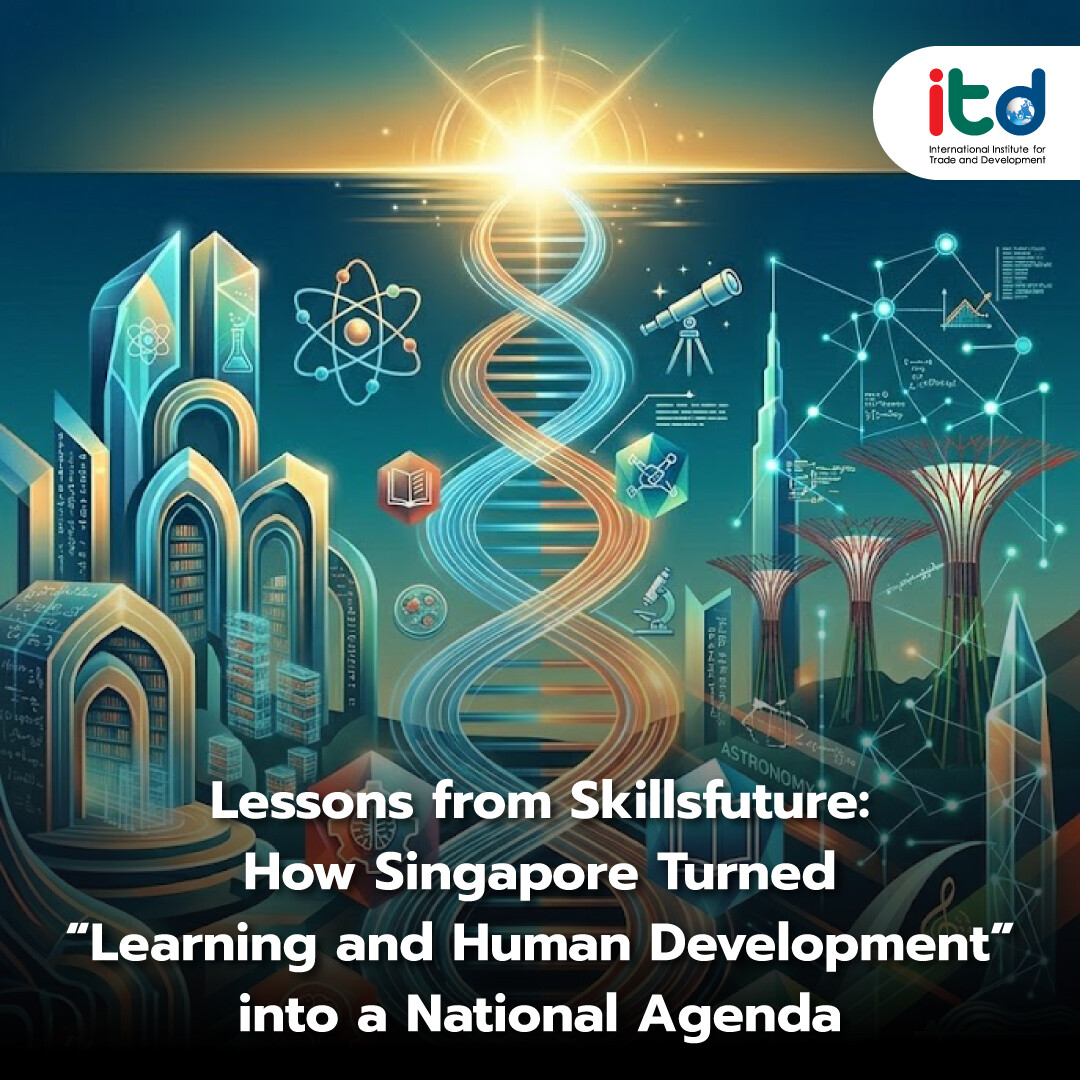
Can you believe that education and human capital development can enable a country to overcome physical limitations and challenges arising from external factors? Not only can they help a country survive amid intensifying competition, but they can also transform a small nation with limited natural resources and little international prominence into a global leader in trade, technology, services, finance, and healthcare. Singapore is a remarkable example of this transformation.
When Singapore attained self-government in 1959 and achieved full independence in 1965, the country faced several significant constraints, particularly physical ones. Singapore is a small country with a land area of just over 700 square kilometers. As an island nation with virtually no natural resources and limited agricultural capacity, it could not rely heavily on domestic resources as the foundation for its economic development. In addition, Singapore faced human capital constraints. At that time, its education and healthcare systems still required substantial development, and many citizens did not yet have adequate access to quality services.
However, all of that now belongs to the past. Looking at Singapore today, the country is a leader in many areas, particularly in education and human capital development. From a nation with an underdeveloped education system, Singapore has become one of the top-performing countries in the world in terms of educational achievement.
This success stems from Singapore’s strong emphasis on human capital development, which was incorporated into the country’s development strategy from an early stage. In 1961, Singapore introduced its First Four-Year State Development Plan, which aimed to prepare the country to become a production base for high-value goods. This was pursued through a commitment to equipping Singaporean workers with basic education and technical skills aligned with market needs, a key factor in attracting foreign investment into the country. Achieving this objective required substantial investment in and development of the education system, reflecting Singapore’s recognition of education and human capital development as the fundamental pillars of national development.
Although many years have passed, Singapore has remained committed to this approach by continuing to promote lifelong learning and the upgrading of skills required in the workplace through government-supported platforms such as SkillsFuture, which was launched in 2015.
SkillsFuture is a platform supported by the Singapore government that aims to encourage citizens to develop and acquire important skills, including new skills that align with labour market demands. It provides learning opportunities for people of all ages, from students to senior citizens
A key feature of this platform is that it allows Singaporeans to enroll in government-recognized courses. These courses are not limited to academic subjects but cover a wide range of skills, including culinary arts, programming, digital marketing, and modern technologies such as AI. Participants receive a certificate upon completing each course.
Viewed as a whole, SkillsFuture serves two main functions. The first is to support upskilling, or the acquisition of new skills to meet the demands of the labour market and future occupations. The second is to support reskilling, or the development of new competencies for workers who have already spent some time in the workforce and need to adapt to changing knowledge, technologies, and ways of working. One example of this reskilling support is the provision of learning subsidies for workers aged 40 and above, enabling them to participate in training and skills development programmes offered through SkillsFuture.
How well has the programme been received? According to SkillsFuture Singapore, more than 606,000 individuals participated in government-supported training programmes in 2025, an increase from 555,000 participants in 2024. In terms of outcomes, more than 51% of participants in the SkillsFuture Career Transition Programme were able to secure new employment within six months of completing the programme. This reflects not only the effectiveness of public policy, but also the importance that Singaporeans place on skills development and lifelong learning.
This is another noteworthy initiative that deserves attention and study, as it highlights the role of government in developing human capital from the ground up and building a strong foundation for the country to overcome various constraints and challenges. The case of Singapore has clearly demonstrated that such an approach can genuinely lead a nation toward success.
An important lesson we can learn from Singapore is that people are a country’s most valuable resource. If governments are able to design policies that effectively support the development of their citizens’ potential, such policies will not merely provide short-term assistance. Rather, they will equip people with the capabilities needed to become self-reliant and adapt to change over the long term. In other words, it is not about giving people fish, but about teaching them how to fish, thereby creating a society of continuous learning and self-improvement.
Author:
Mr. Woraphat Ditpan
Researcher
International Institute for Trade and Development (ITD)
www.itd.or.th
Publication: Bangkok BIZ Newspaper
Section: First Section/World Beat
Volume: 39 Issue: 13176
Date: Wednesday, Jun. 3, 2026
Page: 10 (bottom)
Column: “Asean Insight”