 681
681 


About Documents
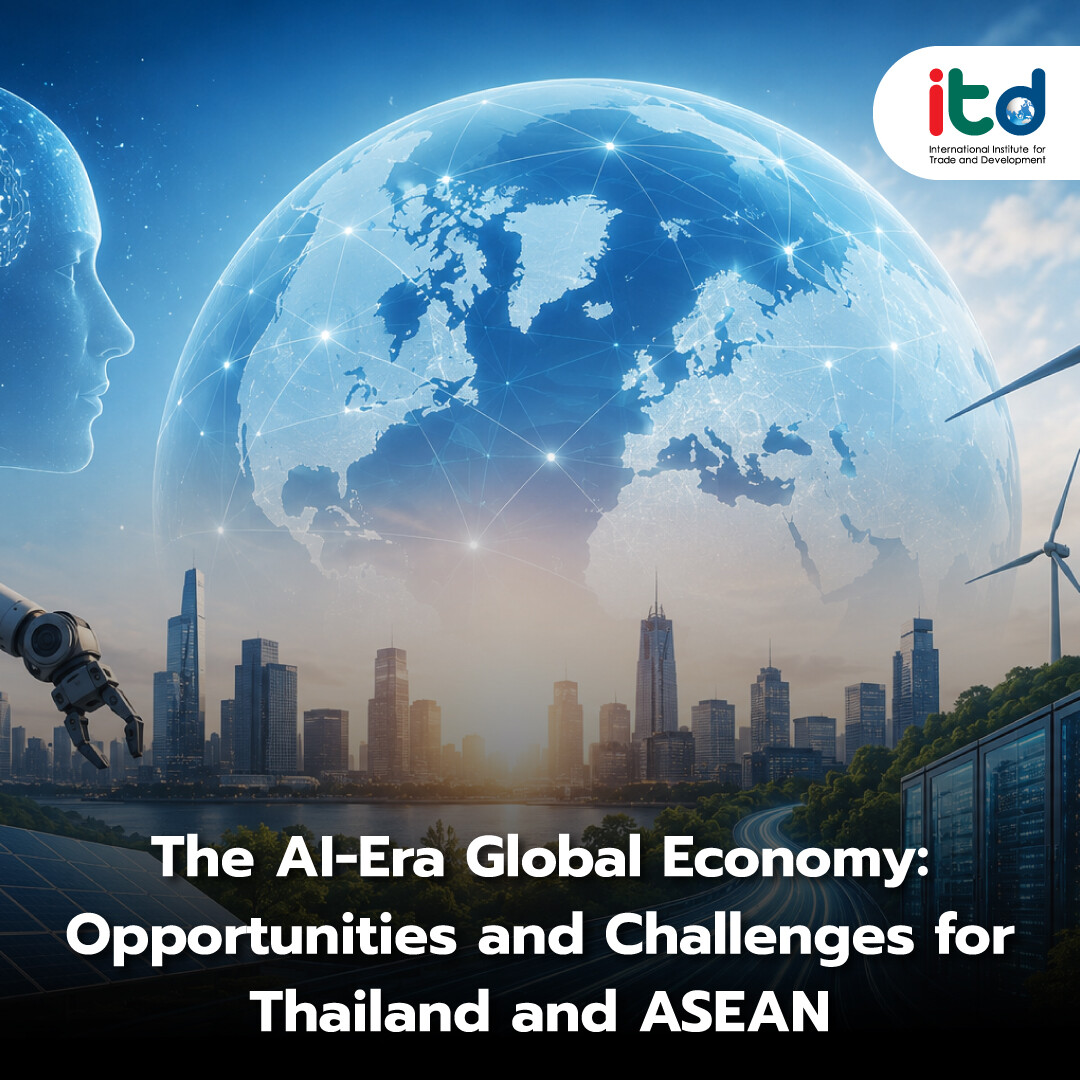
In the twenty-first century, artificial intelligence (AI) is emerging as a general-purpose technology with an influence comparable to electricity or the internet. It may become a key factor in determining the new winners and losers in the global economy. UNCTAD’s Trade and Development Foresights 2026 indicates that global trade growth in 2025 was significantly supported by AI-related goods and infrastructure, including semiconductors, data centres, cloud systems and high-performance computing equipment. These elements are becoming new drivers of the global economy.
However, AI is only one part of a broader transformation. The World Economic Forum’s Technology Convergence Report 2025 suggests that the world is entering a Technology Convergence Era, driven by the integration of AI, quantum computing, robotics, biotechnology, the Internet of Things, space technology, clean energy and advanced materials science. This convergence is creating new products, services and value chains. The WEF explains this development through the 3C Framework: Combination, or the integration of technologies; Convergence, or the restructuring of industries and value chains; and Compounding, or the exponential expansion of impact through business ecosystems. This framework shows that future competitive advantage will not come from possessing a single technology, but from the ability to connect multiple technologies effectively.
This trend is consistent with the WEF’s Top 10 Emerging Technologies 2026, which indicates that many technologies are expected to move from laboratories to commercial application and create tangible impacts over the next three to five years. Future innovation is likely to share three common features: personalized solutions, decentralization of systems and production to better respond to user needs, and greater efficiency by achieving more with fewer resources.
In the energy and environmental dimensions, key technologies attracting attention include Everything-to-Grid energy systems, which allow electric vehicles, batteries and data centres to send power back to the electricity grid during periods of peak demand. These systems can improve energy stability and reduce dependence on fossil fuels. At the same time, Direct Lithium Extraction (DLE) can reduce the time, cost and water use involved in producing minerals for the battery industry and the clean energy transition.
The transformation also extends to environmental and public health dimensions. Radiative cooling materials that can reflect up to 95 percent of sunlight, together with technologies for removing persistent chemicals such as PFAS, are helping to reduce environmental impacts and improve resource efficiency. Meanwhile, precision fermentation, which turns microorganisms into production platforms for proteins, enzymes and medicines, exosome drug delivery, and personalized mRNA cancer vaccines are transforming public health through more precise treatment. Quantum-level simulation for drug discovery can greatly reduce the cost of developing new medicines. World models are advancing AI’s ability to understand and predict real-world behaviour in greater depth, while lattice-based cryptography is becoming an important foundation for cybersecurity in the era of quantum computing.
As a result, global economic competition is no longer centred on producing goods at the lowest possible cost. It is increasingly a competition in technology, data and innovation. Countries that can develop digital infrastructure, build a highly skilled workforce and strengthen innovation ecosystems will be better positioned to attract investment and become centres of new global value chains.
For ASEAN, this transformation presents both opportunities and challenges. The region benefits from its role as a major global production base and from the China+1 strategy. However, if it continues to rely mainly on labour-intensive manufacturing, it may lose competitiveness to countries that can adopt AI and automation more rapidly.
Several countries in the region have therefore begun to set clearer strategic directions. Malaysia is positioning itself as a regional data centre hub. Vietnam is emerging as a new global production base for semiconductors and electronics. Singapore, meanwhile, is building its advantage through leadership in AI governance and digital trade by developing AI regulatory frameworks and promoting digital economy agreements with several countries.
For Thailand, the main challenge is to shift from a traditional production base to an economy driven by knowledge and technology. Although Thailand still has strengths in automobiles, electronics, food and logistics, its future competitiveness will depend on integrating AI into production processes, supply chain management and new product development. Thailand should therefore accelerate investment in AI infrastructure, including data centres, cloud systems and high-performance computing. It should also make use of new-generation free trade agreements, develop AI-related skills and promote a Green-AI Economy that combines technology with clean energy and sustainability goals.
The key question, therefore, is not simply “How should AI be used?” but “How should the country position itself within the new value chains being created by AI?” In a world where AI is converging with energy, biotechnology, materials science and digital systems, national competitiveness will no longer be measured by the lowest labour costs. Instead, it will be measured by the capacity to create innovation, connect technologies and develop an economy that can respond sustainably to the new era of global transformation.
Author:
Ms. Namphueng Tassanaipitukkul
Senior Researcher
International Institute for Trade and Development (ITD)
www.itd.or.th
Publication: Bangkok BIZ Newspaper
Section: First Section/World Beat
Volume: 39 Issue: 13196
Date: Wednesday, Jul. 1, 2026
Page: 8 (bottom)
Column: “Asean Insight”