 22
22 


About Documents
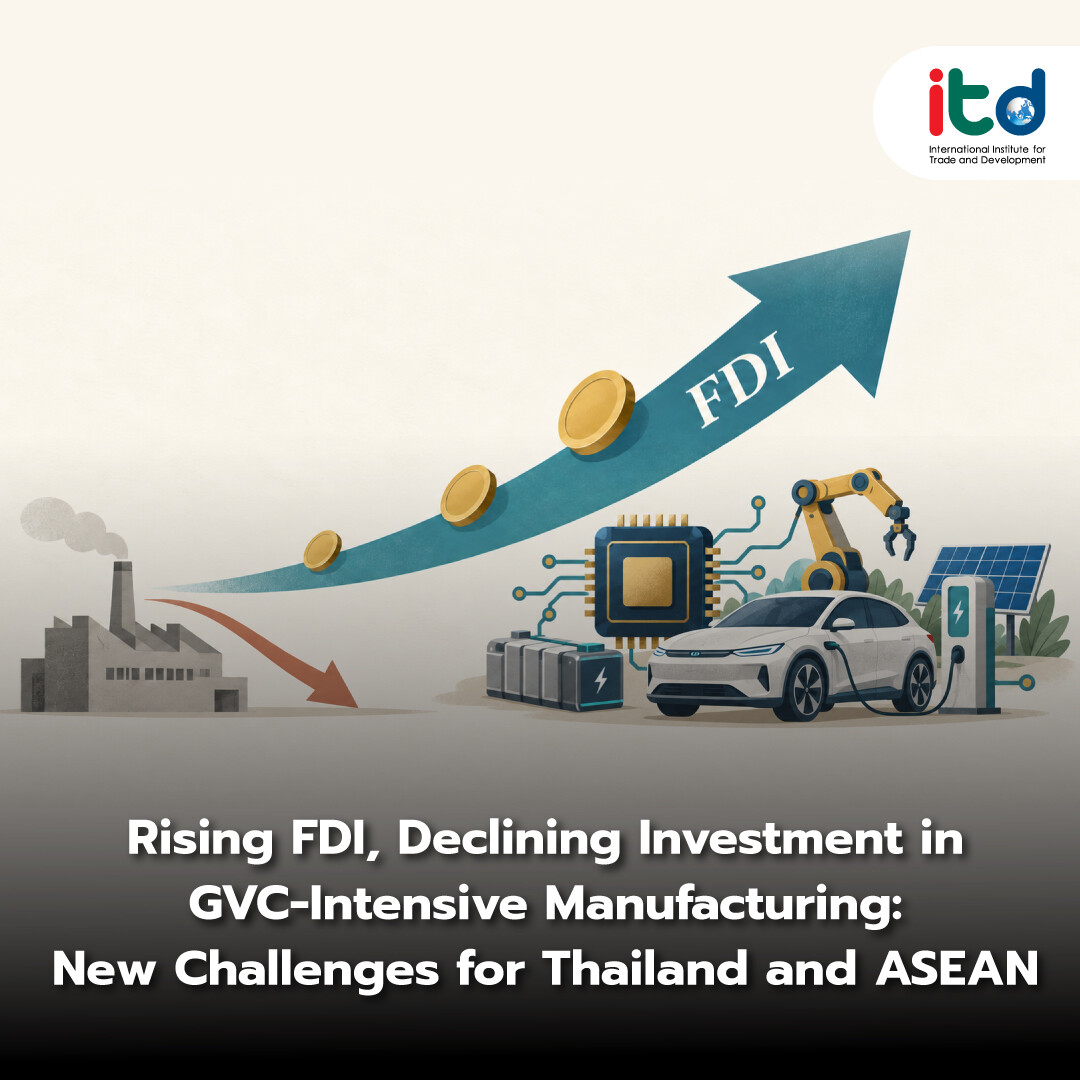
Amid global economic volatility, ASEAN remains one of the leading subregions for attracting foreign investment. Yet the latest UNCTAD figures reveal a notable paradox: while foreign direct investment (FDI) inflows into ASEAN have increased, new investment in manufacturing industries with strong links to global value chains (GVC-intensive manufacturing) has declined sharply.
UNCTAD’s World Investment Report 2026 reports that FDI inflows into Southeast Asia rose by approximately 10%, from US$222 billion to US$244 billion in 2025. Although eight of the subregion’s eleven countries recorded increases, the scale of growth varied considerably, with a few economies accounting for much of the overall increase. Singapore, in particular, ranked among the world’s five largest FDI recipients in 2025, reflecting its role as a headquarters location and financial hub for international investment.
Malaysia and Thailand also recorded substantial increases in FDI inflows, of 51% and 30%, respectively, while inflows into Vietnam rose slightly, by approximately 1%. Investment activity in the subregion remained concentrated in communications, semiconductors, electronics, and renewable energy. Indonesia continued to attract investment in mineral processing, battery-related value chains, and digital infrastructure.
Despite the overall increase in FDI, ASEAN remains exposed to supply chain uncertainty and geopolitical tensions. Rising labor costs in China, changing comparative advantages, and the reorganization of supply chains have encouraged multinational enterprises to relocate some manufacturing activities to other Asian economies, particularly in Southeast Asia. China+1 strategies have reinforced this shift as firms seek to diversify production locations and strengthen supply chain resilience. Nevertheless, investment in GVC-intensive manufacturing in Southeast Asia fell by more than half, from US$31 billion to US$14 billion. This category covers industries such as automotive manufacturing, electronics, machinery and equipment, and textiles.
These figures suggest that rising FDI inflows do not necessarily indicate increased investment in the existing manufacturing base. Instead, they point to a shift in the composition of investment toward high-technology industries and the digital economy, as part of a broader restructuring of global trade and investment.
UNCTAD’s report also examines how ASEAN countries are positioning themselves within these emerging value chains. Malaysia is upgrading from semiconductor assembly toward higher-value activities, including advanced packaging and testing. Its National Semiconductor Strategy supports this transition through workforce development, alongside initiatives to strengthen domestic suppliers and industry–university collaboration.
Vietnam is seeking to build on its electronics assembly base to develop a more complete semiconductor ecosystem. Its semiconductor industry development strategy sets targets for at least 100 design companies, one small-scale semiconductor fabrication plant, and 10 packaging and testing plants by 2030. The country is also linking semiconductor policy to access to clean energy, including direct procurement of renewable electricity and measures to ensure a stable clean energy supply.
Indonesia is drawing on its resource base to attract investment in mineral processing and battery-related value chains, while also receiving investment in digital infrastructure. Thailand, meanwhile, has a relatively diversified industrial base, including automotive manufacturing and electronics, supported by established industrial infrastructure. Although the number of announced greenfield projects in Thailand declined in 2025, their total value increased substantially, driven by large projects in electronics, communications, and digital infrastructure. Thailand is also building on its existing automotive production base, supplier networks, and the Eastern Economic Corridor (EEC) to expand its participation in electric vehicle (EV) value chains.
For Thai businesses, particularly small and medium-sized enterprises (SMEs), opportunities may lie less in competing in upstream activities with high capital and technology requirements than in identifying where they can participate in emerging value chains. Potential opportunities include supplying components and engineering services to the electronics and semiconductor industries; upgrading existing parts suppliers to serve EV and energy transition value chains; and providing advanced industrial services, such as automation, testing, precision engineering, industrial software, and maintenance.
UNCTAD notes that advanced semiconductor manufacturing remains concentrated in economies with strong technological capabilities and well-developed industrial ecosystems. However, developing countries can still find opportunities in assembly, testing, packaging, selected design services, inputs, maintenance, and supplier development. Participation in these activities requires targeted policy support, reliable infrastructure, specialized skills, and close links with lead firms.
In the current FDI landscape, the central issue is therefore not simply how to attract more investment, but how to enable domestic businesses to upgrade their roles and generate greater value within ASEAN’s emerging value chains.
Readers interested in exploring global investment trends in the World Investment Report 2026 and Thailand’s strategic opportunities are invited to attend the international seminar, “Global Investment Trends and Thailand’s Strategic Opportunities,” on September 22, 2026. Further details are available at www.itd.or.th.
——————————
Tag: Foreign Direct Investment, FDI, ASEAN, GVC, World Investment Report 2026, WIR 2026
Author:
Ms. Namphueng Tassanaipitukkul
Senior Researcher
International Institute for Trade and Development (ITD)
www.itd.or.th
Publication: Bangkok BIZ Newspaper
Section: First Section/World Beat
Volume: 39 Issue: 13246
Date: Wednesday, Sep. 9, 2026
Page: 8 (bottom)Column: “Asean Insight”