 38


About Documents
Food security is a state in which everyone has access to enough safe and nutritious food to meet their nutritional and consumption needs, leading to well-being and a good quality of life. In recent years, however, food security has come under mounting pressure from climate change, high inflation and geopolitical conflict. Together, these factors have disrupted global food supply chains, affecting production, trade and access to food in many regions.
ASEAN member states share these challenges. Food security is one of the key issues on the agenda of the 49th ASEAN Summit, being held from 15 to 17 November 2026, a sign of ASEAN’s efforts to deal with food security risks.
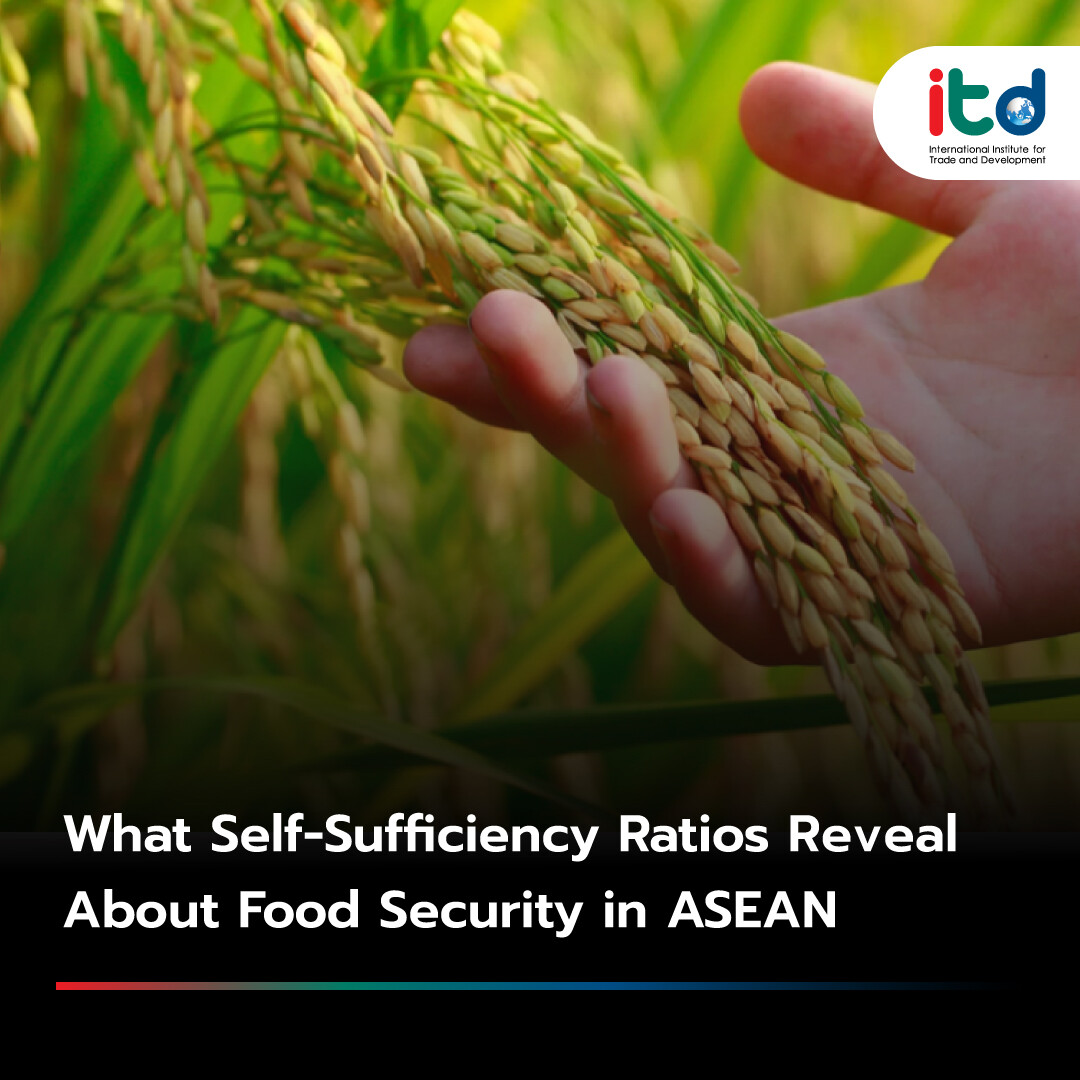
ASEAN’s overall food security can be gauged through the self-sufficiency ratio (SSR), which compares domestic production with domestic utilisation. An SSR above 100% means production is enough to meet demand, with a surplus left over for export or reserves.
A 2026 report from the ASEAN Food Security Information System Secretariat shows that, among key agricultural commodities, ASEAN is self-sufficient in rice (123.6%), cassava (155.3%), and sugarcane (103.6%). This points to the region’s potential and opportunity to become a source of food supply, especially for rice and cassava. Sugarcane production is close to demand, so the region relies on imports only to a small extent. Maize, however, has an SSR of just 71.1%, so imports are needed to meet demand from the livestock sector. Soybeans have the lowest SSR, at 5.9%, a sign of production constraints and dependence on imports.
Looking at individual countries, most produce enough rice for their own needs. Thailand has the highest SSR at 207.9%, followed by Viet Nam, Indonesia, Myanmar, Cambodia and Lao PDR. The Philippines, Malaysia, Brunei Darussalam and Singapore, on the other hand, have SSRs below 100%. They still depend on imports and are more exposed when global rice supply fluctuates.
For other commodities, SSRs differ more from country to country than they do for rice. Myanmar, Lao PDR and Cambodia have surplus maize. Thailand has the largest sugarcane surplus, followed by Cambodia and Lao PDR. For soybeans, only Lao PDR and Cambodia produce more than they need, while Thailand, Lao PDR, Cambodia, Myanmar and Viet Nam all have surplus cassava. The overall picture may be good, but self-sufficiency still varies widely between commodities and between countries. Parts of the food supply chain therefore remain fragile and reliant on outside supply.
Despite these weak spots, several ASEAN countries are working to become food suppliers to the world, both to help other countries achieve food security and to earn export income. Thailand, for instance, has held talks on becoming a strategic food security partner of the United Arab Emirates, while Singapore has signed food security cooperation agreements with Thailand, Viet Nam and Cambodia.
However, SSR only tells us the degree of self-sufficiency and how much surplus is available for export or reserves. It does not show production capacity. Lao PDR’s soybean SSR, for example, is as high as 1,183.6%, but that does not mean the country produces enough to meet other countries’ needs. It may instead mean that domestic consumption is low. Other factors also need to be taken into account before a country can adequately supply food to others.
Therefore, if ASEAN countries want to become a source of food supply both within and beyond the region, they should work together to strengthen food security within the region. That means developing production capacity for commodities still in short supply and distributing supply among member states. Only when its internal foundations are strong can ASEAN become a sustainable food source for its own members and for the rest of the world, while earning export income at the same time.
Author:
Ms. Natjaree Petruang
Researcher, Professional Level
International Institute for Trade and Development (ITD)
www.itd.or.th
Publication: Bangkok BIZ Newspaper
Section: First Section/World Beat
Volume: 40 Issue: 13296
Date: Wednesday, Nov. 18, 2026
Page: 8 (bottom)
Column: “Asean Insight”