 23


About Documents
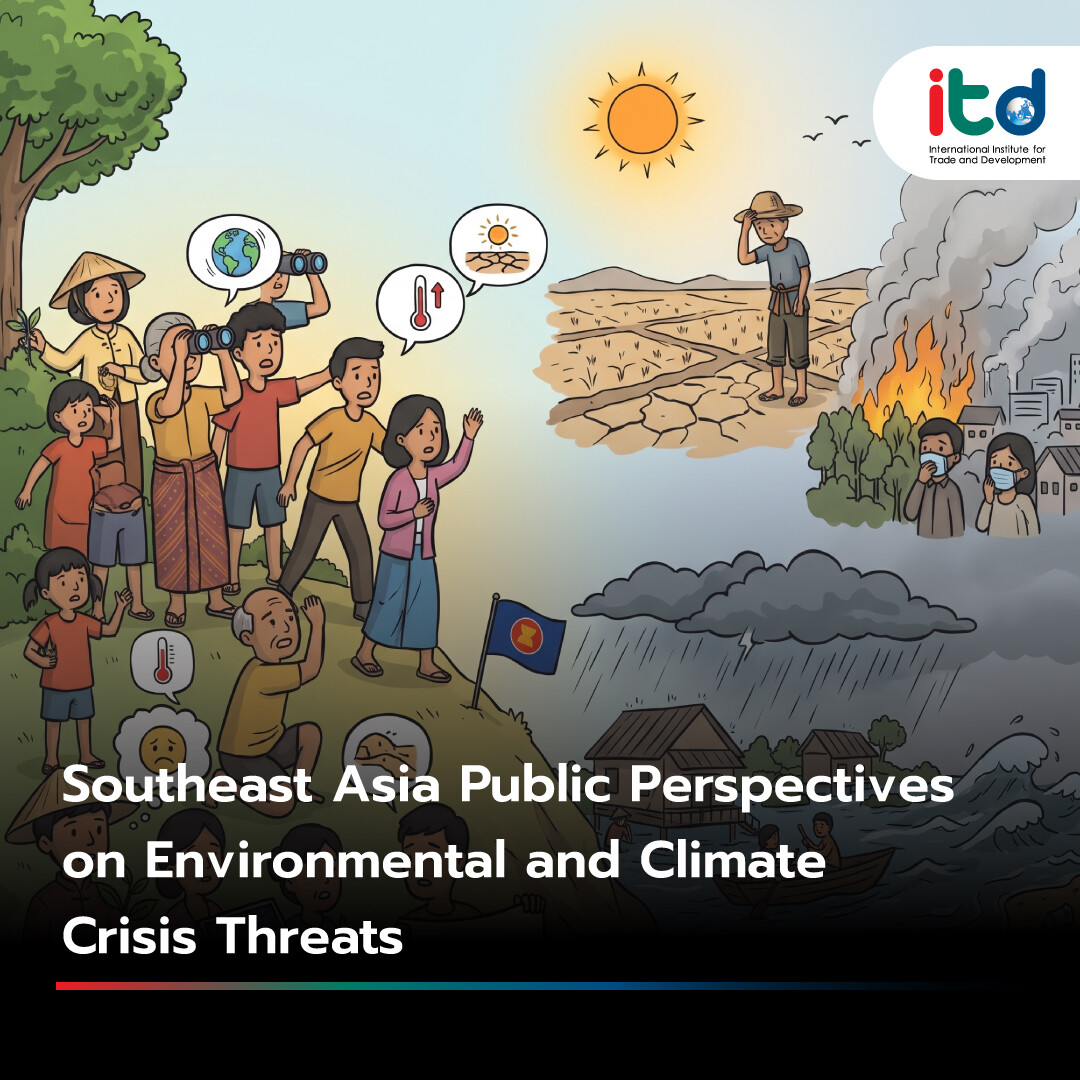
The current climate change situation in the ASEAN region presents unprecedented challenges, ranging from persistent record-breaking heatwaves to severe droughts and wildfires projected to intensify under the “Super El Niño” phenomenon, as well as catastrophic floods recently experienced across Thailand, other ASEAN member states, and East Asian nations such as Japan. Consequently, it is imperative that regional governments proactively prepare for and mitigate the repercussions of climate change to minimize potential damages to vulnerable populations and critical infrastructure.
Examining public perspectives on the climate crisis, as reflected in perceptions, concerns, and expectations regarding climate change and the necessary actions to mitigate its impacts, reveals noteworthy findings across the ASEAN region. According to the Southeast Asia Climate Outlook 2026 Survey Report, jointly published by the ISEAS – Yusof Ishak Institute (ISEAS) and the Lee Kuan Yew Centre for Innovative Cities (LKYCIC) in Singapore, which surveyed respondents across eleven member states, public ranking of prevailing challenges indicates that unemployment and economic recession (55.3%) and climate change and extreme weather (53.6%) constitute the first and second most pressing concerns facing the regional population, with domestic political instability (46.0%) ranking third.
Climate concerns top the list in the Philippines, Vietnam, Singapore, and Malaysia, with the Philippines and Vietnam exhibiting particularly high proportions (72.3% and 71.8%, respectively), consistent with their acute geographic exposure to disaster risks such as tropical cyclones and floods. Conversely, economic concerns dominate in Thailand, Indonesia, Brunei, Timor-Leste, and Cambodia. When queried about the most severe natural hazards currently experienced, floods and extreme heat were rated as the region’s foremost threats, tied for first place, followed by droughts in second and landslides triggered by heavy rain in third. Driven by these climate anxieties, the public maintains a highly proactive stance in supporting clean energy transition policies. Although the energy transition raises apprehensions regarding potential increases in the cost of living, more than half of the respondents continue to support the phase-out of coal-fired power, and as many as 62% endorse national carbon taxation.
In terms of regional cooperation, an overwhelming 77.1% of respondents concurred that ASEAN, as a regional bloc, plays a pivotal role in accelerating the clean energy transition. Singapore is widely recognized as possessing the greatest potential for ASEAN climate leadership, while Japan continues to be regarded as the region’s most preferred and trusted partner for sharing climate expertise, practical technology, and technical know-how.
Hence, it is evident that climate change is no longer a distant reality, its ramifications transcend environmental dimensions to directly impact socio-economic spheres. Beyond domestic policies promoting clean energy transition, both the public and private sectors must prioritize regional international cooperation to interconnect power grids and facilitate long-term technology transfer.
Author:
Mr. Atit Saerepaiboonsub
Researcher, Professional Level
International Institute for Trade and Development (ITD)
www.itd.or.th
Publication: Bangkok BIZ Newspaper
Section: First Section/World Beat
Volume: 40 Issue: 13281
Date: Wednesday, Oct. 28, 2026
Page: 8 (bottom)
Column: “Asean Insight”