 14


About Documents
Amid economic competition and rapid technological change, innovation has become a key driver of productivity growth, value creation, and national competitiveness. However, innovation is not limited to the development of advanced technologies. It also involves drawing on knowledge, traditional know-how, culture, and creativity to develop new products, services, and forms of economic activity.
One important trend is the growth of innovation hubs outside national capitals. Medium-sized cities and cities with specialized strengths are playing an increasingly important role in economic development by building ecosystems that connect educational institutions, businesses, entrepreneurs, and local communities. This suggests that innovation need not be concentrated in major cities. It can also emerge in places with distinctive capabilities and local identities.
In this context, the World Intellectual Property Organization (WIPO) launched the City of Innovation award in 2026 to recognize cities committed to promoting innovation and creativity. Rather than focusing solely on past achievements, the award emphasizes plans and commitments to developing innovation ecosystems over the following 12 months. This allows cities of all sizes to compete on the basis of their own potential. Applications are assessed on the ambition and expected impact of their plans, the alignment of each city’s vision with its local context, and the credibility of its implementation commitments.
On October 12, 2026, WIPO announced three winning cities: Charleroi, Belgium, which emphasizes innovation and workforce skills to support industrial transition; Liverpool, United Kingdom, which seeks to strengthen collaboration among universities, businesses, and government; and Shanghai, China, which prioritizes intellectual property, research, and investment. Despite their different contexts, the three cities share a common approach: connecting knowledge, people, capital, and markets to translate innovation into economic value.
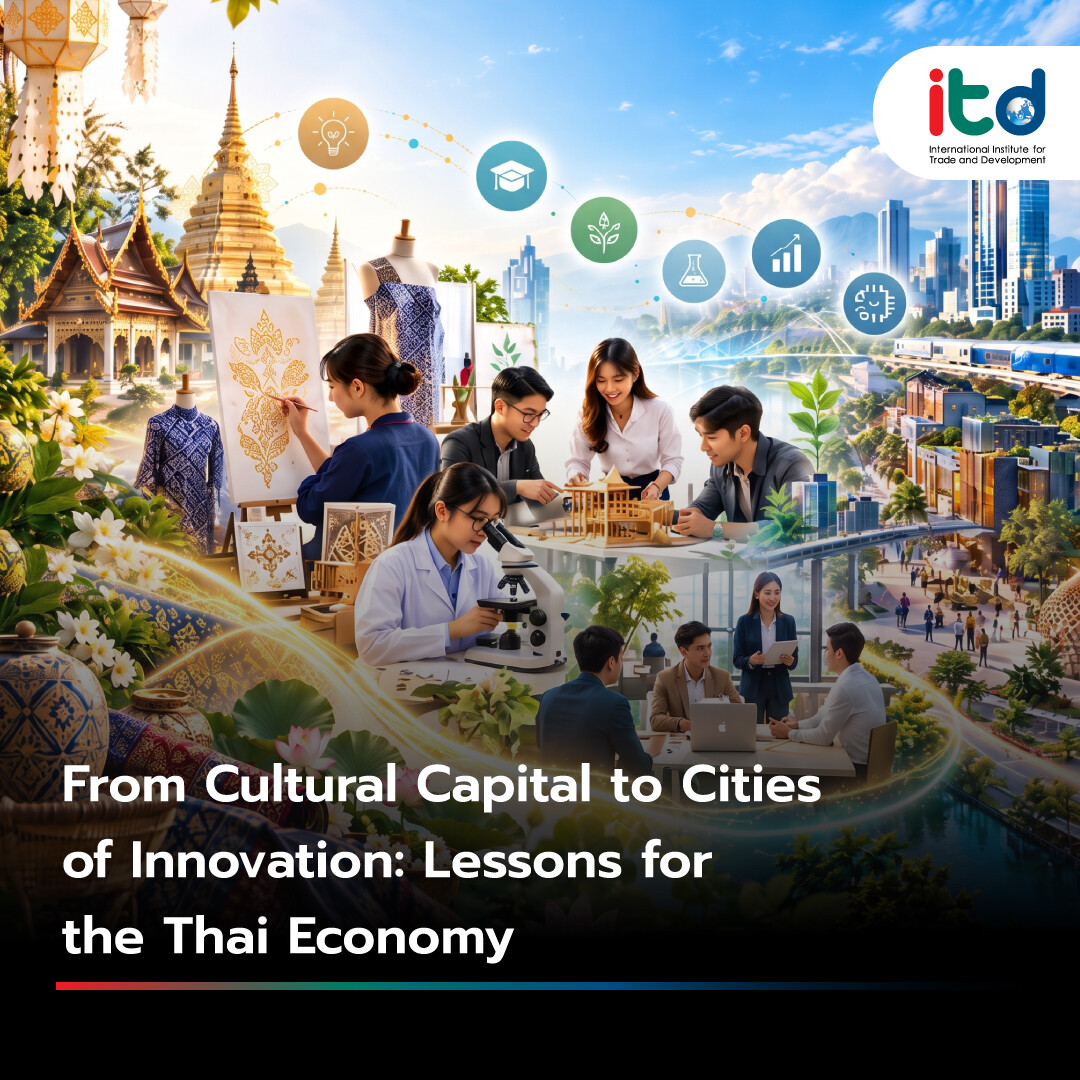
In Thailand, Mueang Lamphun and Roi Et were selected as two of the 15 finalists. Lamphun proposed building on its Lanna cultural capital, particularly Lanna lanterns, through creativity and urban regeneration. Roi Et focused on innovations inspired by the wot, a traditional musical instrument, alongside support for entrepreneurship and the use of intellectual property. A comparison of these approaches suggests that the two Thai cities use cultural capital and creativity as the starting point for development, while the winning cities emphasize systematic connections among research, skills development, business support, and markets.
The central challenge lies in developing processes and tools that connect these support mechanisms so that cultural assets can generate economic value over time. In many parts of Thailand, the creative economy still relies on tourism, festivals, and local products, while substantial scope remains to improve branding, intellectual property management, and access to high-value markets.
Thailand should therefore develop cities of innovation around the strengths of each locality, emphasizing connections among municipal governments, universities, businesses, and communities. Entrepreneurs should receive support from product development and access to finance through to market expansion. Success should be measured by new business formation, income generation, employment, and the benefits reaching local communities, rather than by the number of activities or projects undertaken. The defining feature of a city of innovation is therefore not simply the presence of cultural capital and creativity. It is the capacity to connect these assets and translate them into sustainable economic value. This capacity can help secondary cities become centers of innovation-driven economic activity with distinctive local identities, while strengthening national competitiveness over the long term.
ผู้เขียน
กมล ปานม่วง
นักวิจัยชำนาญการ
สถาบันระหว่างประเทศเพื่อการค้าและการพัฒนา (ITD)
www.itd.or.th
ตีพิมพ์ : หนังสือพิมพ์กรุงเทพธุรกิจ Section : First Section/World Beat
ปีที่ 40 ฉบับที่ 13286 วันพุธที่ 4 พฤศจิกายน 2569
หน้า 8 (ล่าง) คอลัมน์ “Asean Insight”