 202
202 


About Documents
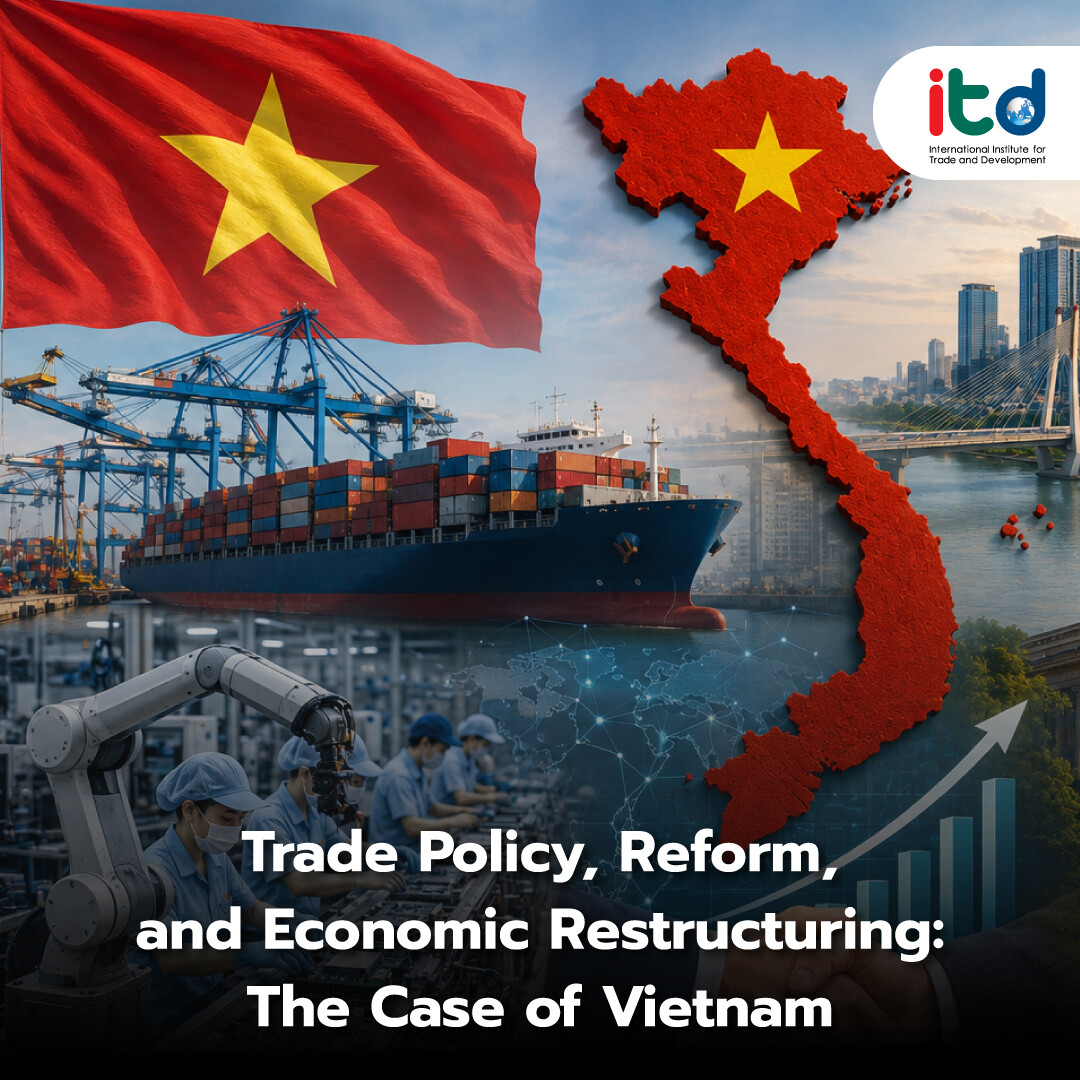
Vietnam represents one of the most notable cases of successful economic transformation in Asia. Within only three decades, the country transitioned from a closed, centrally planned economy heavily dependent on agriculture to a manufacturing and services hub effectively integrated into global supply chains. One of the main drivers of this transformation was the use of trade and investment policies, together with participation in free trade agreements (FTAs), as instruments for promoting and binding domestic institutional and legal reforms.
In 1986, amid a severe economic crisis and the subsequent loss of support from the Soviet Union, the Vietnamese leadership initiated a major reform programme known as Đổi Mới, or “Renovation.” The reforms marked a shift from a closed economic system towards a market-oriented economy and represented an important political achievement over resistance from domestic interest groups. In 1995, Vietnam joined the ASEAN Free Trade Area. Its accession to the World Trade Organization (WTO) as the organization’s 150th member on 11 January 2007 subsequently marked another major turning point.
In political economy, commitment theory explains how governments may use international agreements to make domestic policy commitments more credible and difficult to reverse. The Vietnamese government used WTO accession as an external commitment mechanism that enabled it to remove trade barriers, introduce new investment legislation providing more equal treatment for foreign investors, and reduce the monopolistic role of state-owned enterprises. These reforms would probably have faced strong political resistance if they had been pursued solely through domestic policy processes.
Following the success of its export-oriented development strategy, Vietnam entered a new and more ambitious phase of trade integration in the mid-2010s. This included participation in the Comprehensive and Progressive Agreement for Trans-Pacific Partnership (CPTPP) and the EU–Vietnam Free Trade Agreement (EVFTA). Unlike earlier agreements that focused mainly on tariff reductions, these new-generation FTAs extend to behind-the-border regulations. Their provisions therefore create binding external requirements that exert pressure for domestic regulatory and institutional reform.
Commitments under the CPTPP contributed to Vietnam’s adoption of a revised Labour Code in 2019, which entered into force on 1 January 2021. For the first time, the Code allowed workers to establish enterprise-level workers’ representative organizations outside the state-affiliated Vietnam General Confederation of Labour.
In the area of intellectual property protection, Vietnam amended its Law on Intellectual Property in 2022 to permit the registration of sound marks in accordance with its CPTPP commitments. Most provisions of the amended law entered into force on 1 January 2023.
Government procurement has also been affected by Vietnam’s new-generation trade commitments. The EVFTA includes a dedicated chapter on government procurement and grants foreign suppliers greater access to specified public procurement markets in Vietnam. This includes procurement by designated public institutions and entities in sectors such as healthcare and education, subject to the scope, thresholds, reservations, and transitional arrangements established under the agreement.
However, in more politically sensitive areas, particularly the reform of state-owned enterprises, Vietnam has used negotiated exemptions and extended transition periods to preserve policy flexibility. As a result, the pace of state-owned enterprise reform has remained slower than many observers expected.
As FTA-driven reforms progressed, their effects on Vietnam’s industrial structure became increasingly evident. In development economics, this process is referred to as structural transformation. It involves the reallocation of labour and other productive resources from low-productivity activities, particularly traditional agriculture, to higher-productivity sectors such as manufacturing and modern services.
Quantitative modelling conducted by the Economic Research Institute for ASEAN and East Asia (ERIA) illustrates the scale of Vietnam’s labour reallocation. The share of employment in manufacturing increased rapidly and rose well above the levels observed in countries with comparable per capita incomes. Productivity gains resulting from workers’ movement into more productive occupations became a major source of Vietnam’s economic growth, which averaged nearly 7 per cent annually over several decades.
From a development economics perspective, an assessment of Vietnam’s economic future cannot be based solely on short-term growth rates. It must also examine the country’s position within the broader process of structural transformation. One relevant analytical approach is to compare the manufacturing employment share with per capita income, using cross-country empirical patterns as a benchmark.
Vietnam’s productivity growth has been driven substantially by the movement of workers from low-productivity agriculture to higher-productivity manufacturing. Consequently, the country’s manufacturing employment share has risen significantly above the level predicted by the conventional development trajectory. However, economic theory also highlights the risk of premature deindustrialization, a process in which the share of industrial employment begins to decline before a country has reached a high level of income.
If Vietnam is to achieve its objective of becoming a high-income country by 2045, while maintaining annual economic growth of at least 6 per cent, continued reliance on the transfer of labour from agriculture to industry will no longer be sufficient. The next stage of development will depend not primarily on expanding the number or size of factories, but on increasing within-sector productivity.
The Vietnamese government must therefore use new-generation FTAs to support deeper institutional reforms. Priority areas include the effective enforcement of intellectual property rights, the development of competitive and adaptable modern service sectors, stronger innovation capabilities, and further reform of state-owned enterprises. Progress in these areas will be necessary for Vietnam to overcome middle-income and structural development traps and establish a sustainable path towards high-income status.
Author:
Mr. Wimon Punkong
Deputy Executive Director (Academic)
International Institute for Trade and Development (ITD)
www.itd.or.th
Publication: Bangkok BIZ Newspaper
Section: First Section/World Beat
Volume: 39 Issue: 13221
Date: Wednesday, Aug. 5, 2026
Page: 8 (bottom-right)
Column: “Asean Insight”