 12
12 


About Documents
The 2026 Annual Meetings of the International Monetary Fund (IMF) and the World Bank Group in Bangkok present an important opportunity to place climate change and health on the global financial agenda. This reflects a broader shift toward recognizing environmental and public health challenges as interconnected sources of systemic fiscal risk. Air pollution, particularly fine particulate matter (PM2.5), and global warming not only threaten human health and lives but also increase public healthcare expenditure, reduce labor productivity, and impose indirect costs on the national economy.
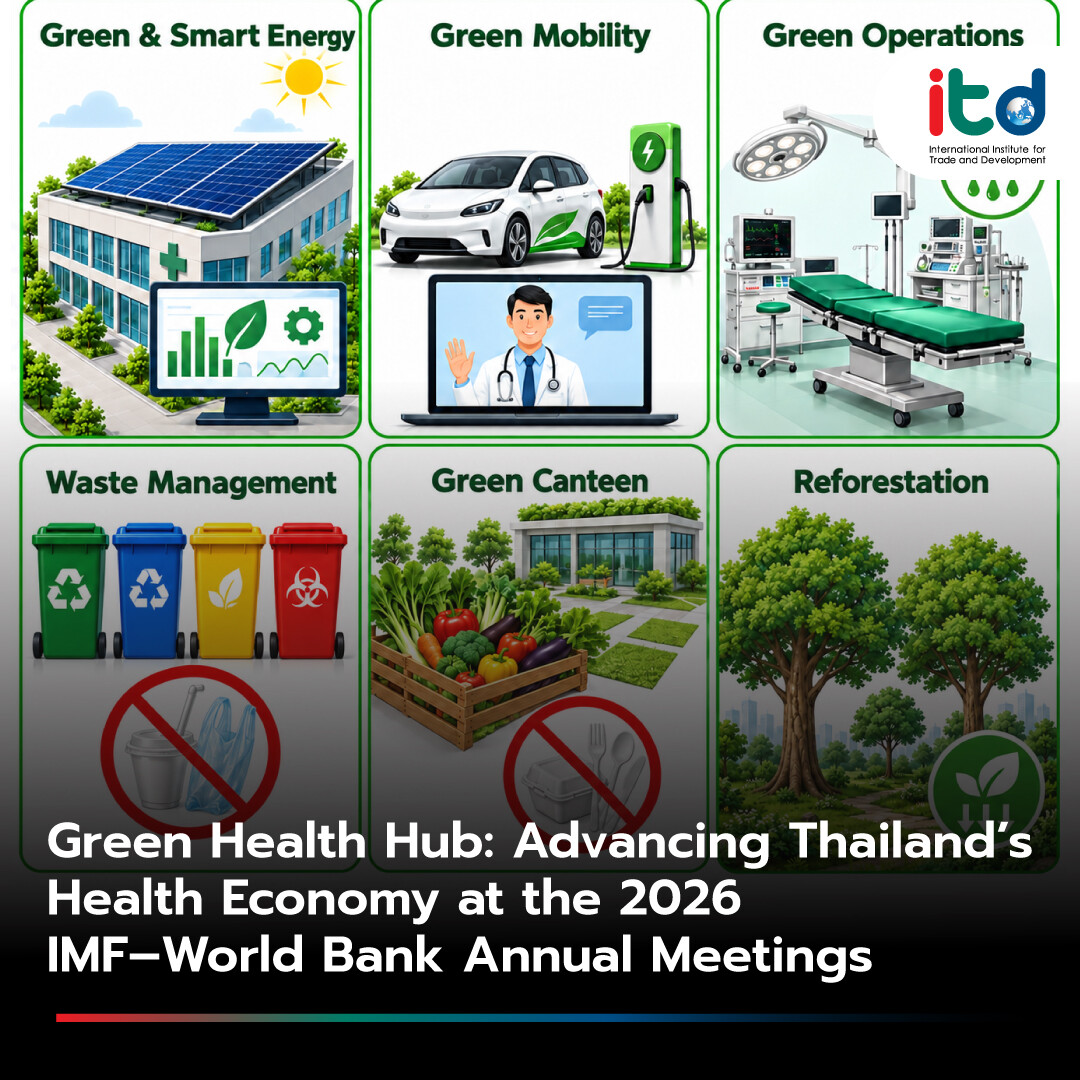
Thailand has several strengths that could support its development as a regional Green Health Hub. Its universal health coverage system provides access to essential healthcare services, while its healthcare professionals, hospitals, and health service industries have extensive experience serving both domestic and international patients. Thailand also has considerable potential in traditional Thai medicine, herbal products, bio-based industries, and innovations aligned with the Bio-Circular-Green (BCG) Economy Model. These strengths provide a foundation for developing healthcare services that reduce environmental impacts while improving quality, safety, and competitiveness.
Hosting the 2026 Annual Meetings offers Thailand a strategic opportunity to attract green finance into its healthcare system. In particular, Thailand could explore environmental and health financing mechanisms in three key areas.
1. Mobilizing Finance through Green and Sustainability Bonds
Thailand could use this international platform to engage with the Green Climate Fund (GCF) and the World Bank Group to secure grants and concessional financing for transforming hospitals nationwide into green hospitals. Priority investments could include renewable energy systems, low-carbon infectious waste management, and climate-resilient hospital infrastructure designed to withstand natural disasters.
2. Strengthening Policies to Address PM2.5 Air Pollution
Thailand could apply IMF approaches to estimating the health-related economic costs of air pollution to support evidence-based policymaking. Such assessments could provide an economic rationale for accelerating the implementation of clean air legislation and introducing carbon taxation. Revenue generated through environmental taxation could be allocated to public health financing mechanisms to address pollution-related health impacts.
3. Promoting Health–Climate Technology Innovation
Investment in health–climate technologies could create opportunities for private companies and startups to develop data analytics tools for predicting climate-related health risks, telemedicine systems, and disease surveillance technologies. These innovations could strengthen healthcare preparedness and improve the capacity of the health system to respond to environmental and climate-related threats.
However, Thailand must address several structural challenges to realize these opportunities. First, reliable estimates of the economic losses associated with air pollution and climate change are needed to integrate environmental health risks into fiscal planning. Second, regulatory barriers and lengthy approval procedures may delay the adoption of green healthcare innovations. Third, unequal access to financing could widen existing disparities, as investments may be concentrated in well-resourced areas while community hospitals and populations exposed to severe pollution receive insufficient support. In addition, emerging healthcare technologies must undergo rigorous assessments of cost-effectiveness, safety, and data protection.
The 2026 IMF–World Bank Annual Meetings therefore represent more than an international financial forum. They offer Thailand an opportunity to connect the strengths of its healthcare system with green investment and climate risk management. By improving the reliability of health and economic data, establishing innovation-friendly regulations, ensuring transparent financing, and expanding access to investment across all levels of healthcare, Thailand could strengthen its position as a regional Green and Climate-Resilient Health Hub and support the long-term sustainability of its health economy.
Author:
Mrs. Paveenuch Udommaneetanakit
Senior Researcher
International Institute for Trade and Development (ITD)
www.itd.or.th
Publication: Bangkok BIZ Newspaper
Section: First Section/World Beat
Volume: 40 Issue: 13271
Date: Wednesday, Oct. 14, 2026
Page: 8 (bottom)
Column: “Asean Insight”