 22


About Documents
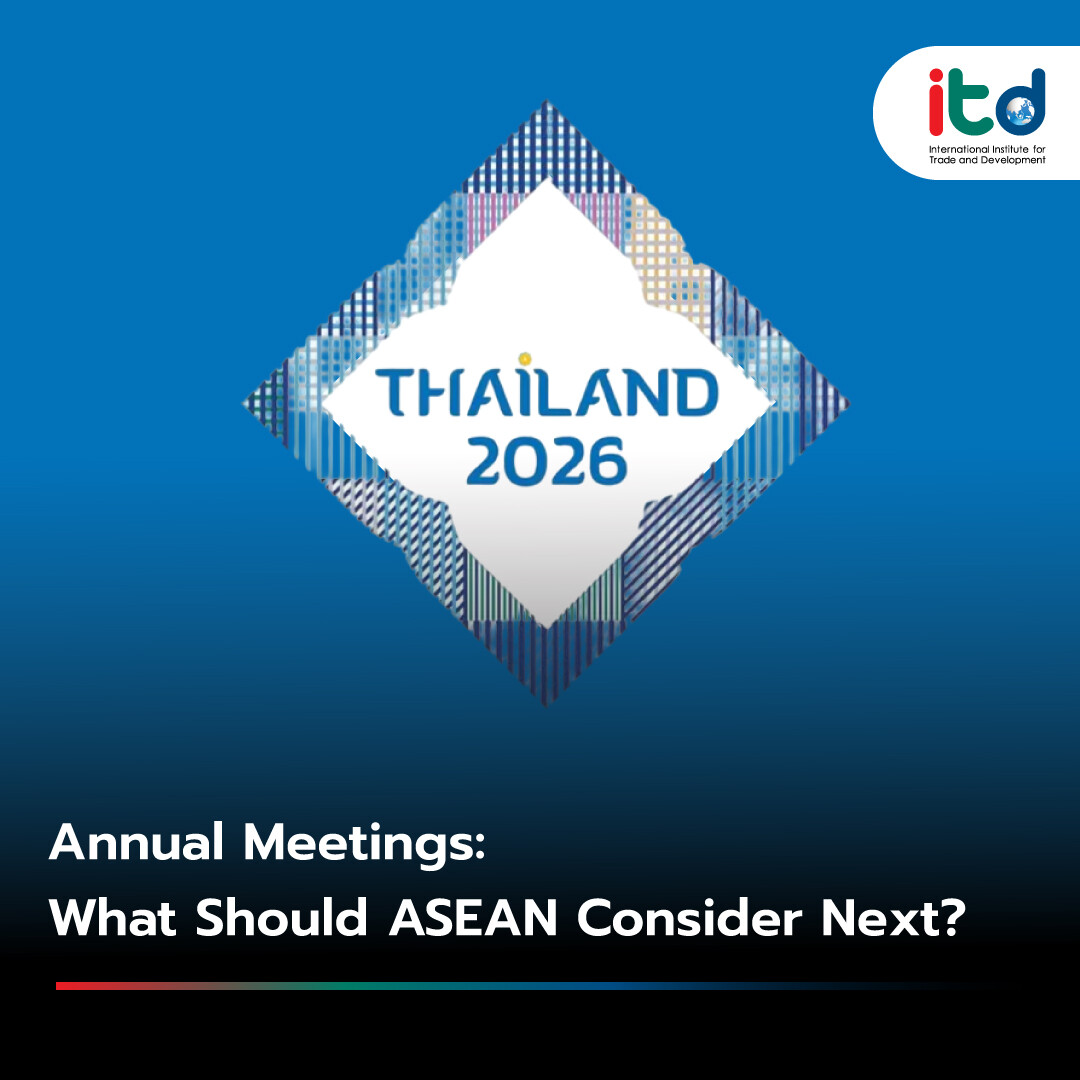
Last week, Thailand hosted the 2026 Annual Meetings of the International Monetary Fund (IMF) and the World Bank Group, which can be likened to the “Olympics of Global Finance.” Economic and financial leaders from around the world gathered to exchange views on the global economic situation and approaches to addressing shared challenges.
Amid challenges to multilateralism, economic cooperation remains important, particularly regional cooperation, which may serve as a key mechanism for responding to changes in the global economy. This article therefore aims to summarise the key issues discussed at the meetings and analyse their implications for ASEAN, focusing on three main areas.
First, the rapid development of artificial intelligence (AI) was a key topic of interest in terms of both opportunities and risks. Kristalina Georgieva, Managing Director of the IMF, emphasised the potential risks that could arise in the absence of appropriate regulatory measures and ethical frameworks. From another perspective, the rapid growth of the AI industry also presents opportunities for several ASEAN countries involved in the AI technology supply chain to benefit from this expansion. However, the key question is how the benefits of investment, increased productivity, and economic growth (economic gains) can be distributed more broadly across different sectors, including workers and countries across the region, and how AI can be used to enhance productivity across economic systems.
Second, job creation and workforce development. Ajay Banga, President of the World Bank, emphasised the importance of job creation at the meetings. One noteworthy figure is that approximately 1.2 billion young people are expected to enter the labour market over the next 15 years, while only 420 million jobs are projected to be available. This highlights the challenge of creating sufficient employment opportunities for the next generation of workers. This does not yet account for the impact of AI adoption in replacing certain types of jobs, which may incentivise employers to use technology instead of hiring workers, particularly for entry-level positions.
This situation further underscores the need to develop human infrastructure, ranging from education and public health systems to social environments conducive to reskilling and upskilling, in order to prepare the workforce for future labour markets. At the same time, a key question is how the AI industry and emerging industries can create additional jobs and economic opportunities to accommodate young people entering the labour market.
Finally, demographic structure and the enhancement of economic productivity. Beyond employment challenges, demographic shifts towards ageing societies also affect labour productivity, income, and public expenditure worldwide. Atsushi Mimura, Japan’s Vice Minister of Finance for International Affairs, presented an insightful perspective based on Japan’s experience, demonstrating that although population ageing creates economic challenges, it can also open up opportunities for the development of new industries known as the “Silver Economy.” A key question is the extent to which these industries can create employment opportunities and accommodate the next generation entering the labour market.
In the context of ASEAN, the region has been recognised as an area with significant economic potential and opportunities amid global economic volatility. One of its key strengths is its openness to trade with countries around the world. Nevertheless, ASEAN needs to strengthen intra-regional cooperation. The panel discussion entitled ASEAN in a Changing Global Landscape emphasised the importance of increasing trade among member states to help address external uncertainties.
When considered alongside the issues of AI, employment, and ageing societies, it becomes clear that member states have different strengths and face different challenges. The Philippines has a large labour force, while some countries are facing ageing societies. The question is how ASEAN can promote cross-border labour mobility in a manner that aligns with the needs of individual countries. Meanwhile, Indonesia possesses nickel resources that are important to the electric vehicle (EV) industry, while Laos and Myanmar have energy potential that could be linked to demand from other countries in the region, such as Singapore.
The key challenge, therefore, is not merely to leverage the strengths of individual countries, but to coordinate these capabilities through regional cooperation so that member states can collectively address shared economic challenges and achieve more inclusive growth.
Author:
Mr. Woraphat Ditpan
Researcher
International Institute for Trade and Development (ITD)
www.itd.or.th
Publication: Bangkok BIZ Newspaper
Section: First Section/World Beat
Volume: 40 Issue: 13276
Date: Wednesday, Oct. 21, 2026
Page: 8 (bottom)
Column: “Asean Insight”