 346
346 


About Documents
The world in the twenty-first century is facing multiple challenges arising from wars, geopolitical conflicts, climate change, and vulnerabilities in global supply chains. These challenges have made food security a national security priority for many countries.
Food is therefore no longer viewed merely as an agricultural commodity for trade. It has become a strategic resource that can strengthen bargaining power and promote international cooperation. Countries that can provide a continuous and reliable food supply are more likely to gain recognition as trusted partners in global food security.
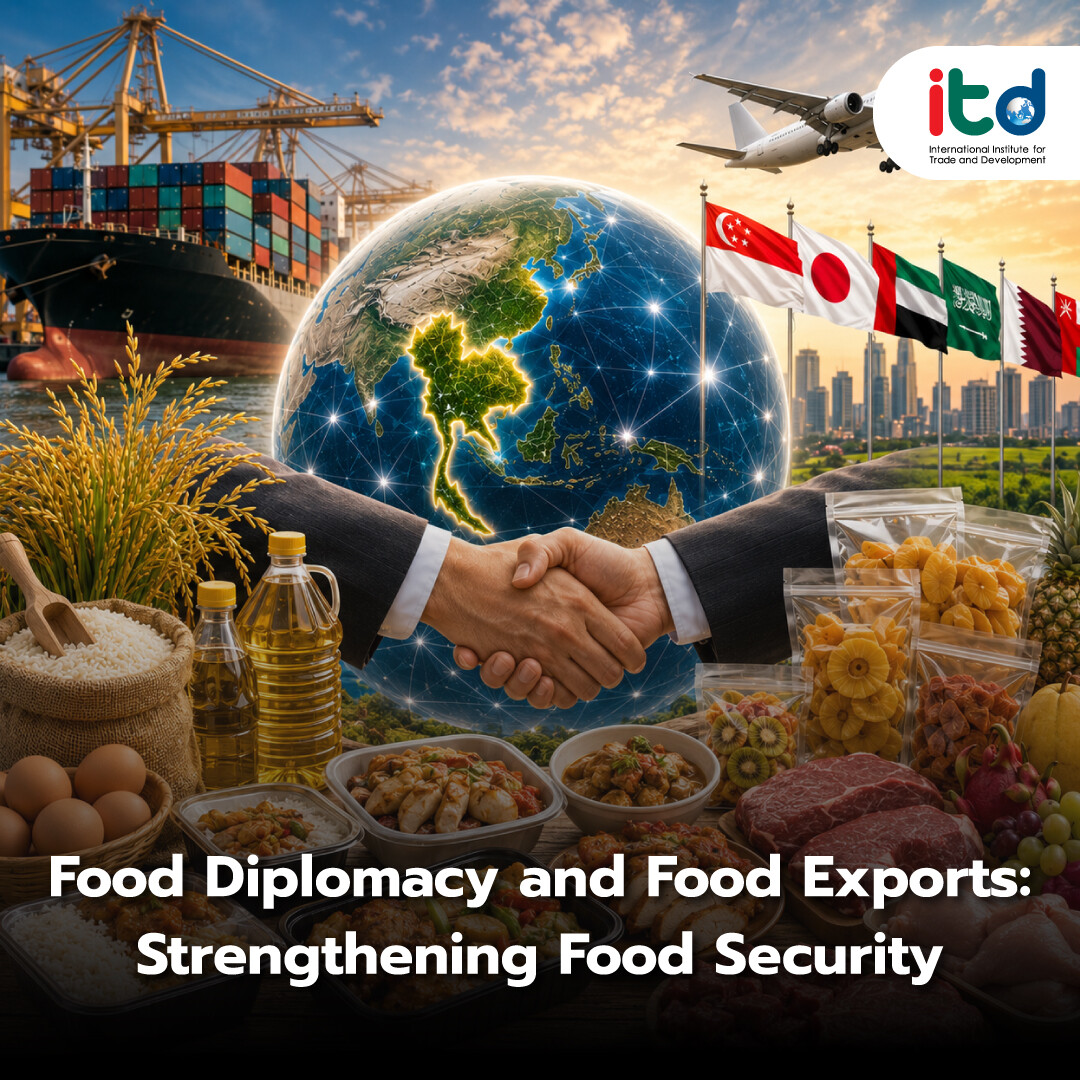
Thailand has long been recognized as the “Kitchen of the World” because of its strong capacity to produce high-quality rice, poultry, fruit, seafood, and processed food products. However, changes in the global environment require Thailand to shift its approach to food exports. Rather than focusing solely on export revenue, the country should seek to establish long-term relationships with countries that depend on food imports to ensure the well-being and security of their populations.
This approach lies at the core of food diplomacy, which uses cooperation in the food sector as an instrument for strengthening both national security and international relations.
However, export promotion cannot be pursued without considering Thailand’s domestic food security. The government should therefore conduct a comprehensive assessment of the production capacity, market conditions, and strategic importance of each food category. High-value-added products, including processed foods, ready-to-eat meals, cooked poultry products, processed fruit, and halal food, should receive strong export support.
At the same time, essential consumer goods and strategically important food products, such as rice, eggs, vegetable oil, meat, processed foods, and emergency food supplies, should be carefully managed. Particular attention should be given to maintaining adequate domestic supplies during periods of global food crisis.
Thailand’s strategic export markets do not necessarily have to be the world’s largest economies. Greater priority should be given to countries with a high level of dependence on food imports, including Singapore, Japan, the Gulf states, and island countries with limited agricultural land. These countries are seeking reliable partners that can maintain a stable food supply under long-term agreements.
Thailand therefore has a clear opportunity to move beyond its conventional role as a food supplier and become a provider of food security assurance for its trading partners.
Despite being one of the world’s major food exporters, Thailand still lacks a systematic national mechanism for food security management. Several government agencies are currently responsible for managing commodity stocks and supporting government policies. However, these agencies do not yet operate as part of a fully integrated strategic food reserve system that connects data on production, consumption, exports, and risk assessment.
Thailand should therefore develop a national strategic food reserve system that establishes minimum reserve levels for essential food products. The system should also use real-time data to support decisions on food exports and the stabilization of domestic markets.
Implementing such a policy requires coordinated action across government ministries, including the Ministry of Agriculture and Cooperatives, the Ministry of Industry, the Ministry of Commerce, the Ministry of Transport, the Ministry of Foreign Affairs, and national security agencies. These institutions should jointly formulate strategies covering food production, strategic reserves, international trade, logistics, and food diplomacy.
In the future, competition in the global food sector will not be determined solely by which country can produce the largest quantity of food. It will increasingly depend on which country can deliver food in the most stable, safe, and reliable manner.
If Thailand can systematically integrate its policies on food production, strategic reserves, exports, and diplomacy, it will not only maintain its position as the “Kitchen of the World” but also become an important food security partner at both the regional and global levels. Such a role would contribute to Thailand’s economic security, national security, and long-term sustainability.
Author:
Dr. Punrop Rajapongsa
Director, Office of Research Development and Promotion
International Institute for Trade and Development (ITD)
www.itd.or.th
Publication: Bangkok BIZ Newspaper
Section: First Section/World Beat
Volume: 39 Issue: 13216
Date: Wednesday, Jul. 29, 2026
Page: 12 (bottom)
Column: “Asean Insight”